

We'll cover
How to Check ATS Score of Your Resume Using an Online ATS Scanner
Written by Palak Jain

- ATS score shows resume match and readability for job filtering.
- Higher score increases chances of passing initial screening.
- Use tools like ResuScan to scan, identify gaps, and improve resume.
- Focus on keywords, simple formatting, measurable achievements.
- Regularly optimize resume to reach 80%+ score and results.
We'll cover:
What Is an ATS Score?
An ATS (Applicant Tracking System) score is a percentage or rating showing how well your resume matches a job description. It is calculated by software that scans keywords, skills, and formatting. A higher score means better alignment with the role and higher chances of passing initial resume screening.
ATS score measures how well your resume matches job requirements.
- Score between 0–100: A resume ATS score checker gives a clear percentage based on how optimize resume ATS score is
- Keyword matching: It checks if your resume includes the same terms used in the job description
- Formatting compatibility: Ensures your resume is readable without errors by ATS systems
- Content strength: Looks at measurable achievements, clarity, and relevance
When you check ATS score, you’re basically testing how your resume performs before sending it to a recruiter. From recruiter behavior, resumes are filtered quickly, and only the top-matching ones move forward.
A good score usually falls above 75–80, which is considered strong in most hiring scenarios. Using an ATS score checker free tool helps you understand if your resume is ready or needs improvement.
In real job searches, candidates who regularly check ATS score of resume tend to get better results because they fix issues early instead of applying blindly.
MYTH AND REALITY
Most job seekers misunderstand how ATS tools actually work. Here’s what’s really happening behind the scenes:
Why Checking ATS Score Matters ?
Checking your ATS (Applicant Tracking System) score is important because many resumes are filtered out before a recruiter ever sees them. A strong ATS score shows your resume matches the job well, uses the right keywords and formatting, and improves your ranking in the system, increasing your chances of getting interviews.
In real job searches, many candidates apply to dozens of roles but never hear back—often because their resumes don’t meet basic ATS requirements.
- Avoid getting filtered out early: A low score means your resume may never reach a recruiter
- Understand your weak areas: An ATS score checker shows exactly what’s missing or wrong
- Improve job matching: Helps align your resume with specific job descriptions
- Save time in applications: Focus on applying with a strong, optimized resume
Most ATS systems prioritize keyword matching over formatting. That’s why using a free ATS score checker gives clarity on whether your resume includes the right keywords.
Based on hiring trends, companies rely heavily on ATS to manage large volumes of applications. If you don’t check ATS score, you’re missing a critical step in the job search process.
Customizing your resume for each job increases ATS success. When you consistently use an ATS score checker, you move from random applications to targeted ones, which improves your chances of getting shortlisted.
How to Check ATS Score of Resume (Step-by-Step)
To check your resume’s ATS (Applicant Tracking System) score, upload your resume to ResuScan, an advanced resume scanning tool that evaluates it across 40+ key factors. It checks ATS compatibility, keyword usage, formatting, and structure, then generates a score to help you optimize your resume and improve your chances of getting noticed by HR and passing ATS filters.
Step 1: Search for ATS Resume Checkers
Start simple. Go to Google and type free ATS resume checkers. You’ll see multiple tools that can scan your resume in seconds. You don’t need to overthink which one to pick—just choose a reliable one and get started.
Step 2: Upload Your Resume
Once you open a tool, upload your resume file. Most platforms support PDF and Word formats. The process is quick, and within a few seconds, the system will analyze your resume.
Step 3: Check Your ATS Score
After the scan, you’ll see an ATS score, usually out of 100. This score tells you how easy it is for systems to read your resume and how well it aligns with job requirements. ResuScan recommends an ATS score of 80+ for better visibility and shortlist chances. As of Q1 2026, only 5% of resumes achieve an ATS score above 80% on ResuScan’s 40+ criteria evaluation system.
Step 4: Use ResuScan if Your Score is Low
If your score is below 80%, don’t ignore it. This is where most candidates lose opportunities. Search for ResuScan and upload your resume there. Resumes optimized using ResuScan’s ATS tools are more likely to get shortlisted faster by recruiters and ATS systems.
Step 5: Fix Issues and Recheck
ResuScan doesn’t just give a score—it points out real problems. Things like poor formatting, missing keywords, weak bullet points, or unnecessary repetition. Work on those areas, make small improvements, and then scan your resume again to see if your score improves.
Taking a few extra minutes to check your resume before applying can save you from a lot of silent rejections. It’s a small step, but it makes your applications much stronger.
What Does ATS Check in a Resume?
An Applicant Tracking System (ATS) scans, parses, and ranks resumes to determine how well they match a job description. It looks for relevant keywords, job titles, skills, and work experience while also evaluating formatting. Simple, structured resumes are preferred, while complex elements like graphics, tables, or text boxes can reduce readability and performance.
- Keyword relevance: ATS compares your resume with the job description to see if the right skills and terms are included. That’s why using a resume ATS score checker helps identify missing keywords.
- Resume structure: It checks if your resume has clear sections like Experience, Skills, and Education. Poor structure can lower your score when you check ATS score of resume.
- Formatting and readability: ATS avoids resumes with images, tables, or complex layouts. A simple format works best when using an ATS score checker free tool.
- Content quality and impact: It looks for measurable achievements instead of generic statements. Strong results improve your overall ATS score.
- Keyword balance and repetition: Too many repeated keywords can hurt your score. Good resumes maintain a natural balance.
Top resumes contain 30–40 targeted keywords. So when you check ATS score, you should focus on relevance, not just quantity.
Best Free ATS Resume Checker Tools
Free tools help you check ATS score and understand what’s stopping your resume from getting shortlisted. Instead of guessing, you get clear insights on what to fix before applying.
ResuScan by Mployee.me is built to go deeper than a basic ATS score checker tool. It evaluates your resume on an ATS score using 40+ ATS factors like font size, images, measurable impact, keywords, buzzwords, repetition, and overall resume parsing success rate. As per Quarter 1 2026, this resume scanner for jobs has already scanned 7 lakh+ resumes from 4 lakh+ users, which gives a strong view of how resumes actually perform in real hiring scenarios.
- Checks overall resume strength: Reviews formatting, structure, and readability to ensure your resume is ATS-friendly
- Analyzes keyword relevance: Helps you match job descriptions better when you check ATS score of resume
- Identifies weak content: Flags missing impact, vague points, and overused buzzwords
- Improves section clarity Suggests better structuring for Experience, Skills, and other key sections
- Tracks improvement over time: Lets you recheck and refine your resume until you reach a strong score
- Validates resume readability: Ensures your resume is properly parsed by ATS without errors
Resumes with 80%+ ATS score get shortlisted faster. Using a reliable resume ATS score checker like this helps you move toward that range with clear, actionable steps.
Resume Score Transformation with ResuScan
See how a resume can improve after optimizing with ResuScan. Real improvements, measurable results.
Before ResuScan
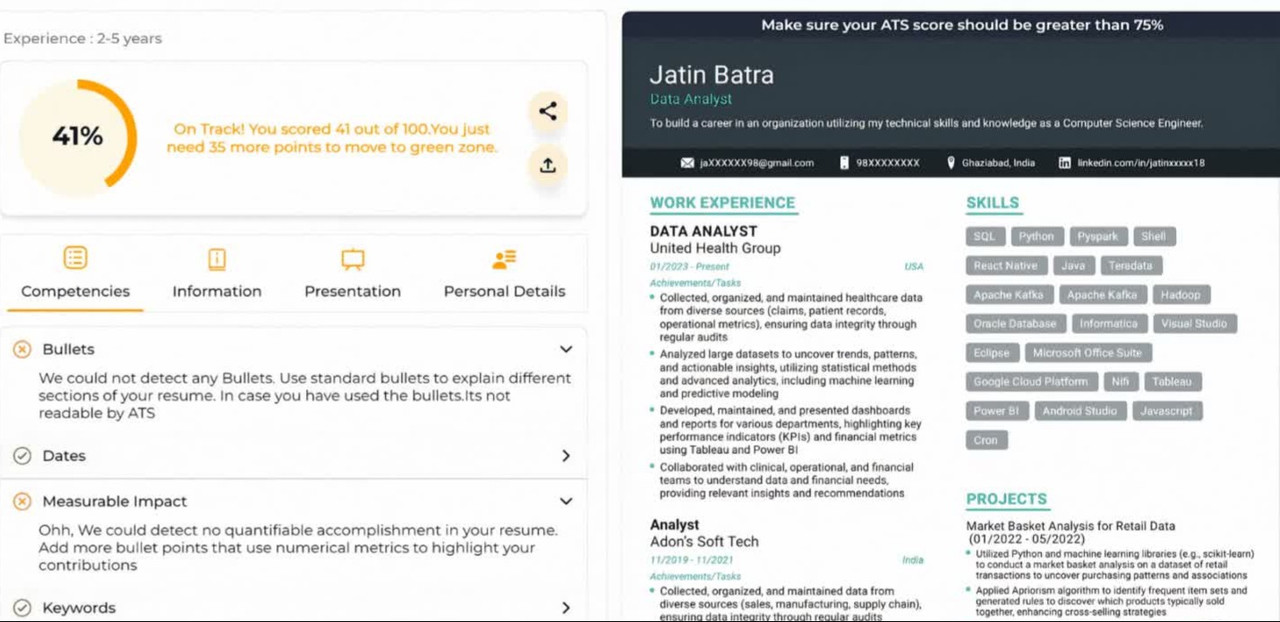
- Poor keyword alignment
- No dates
- Formatting not ATS-friendly
After ResuScan
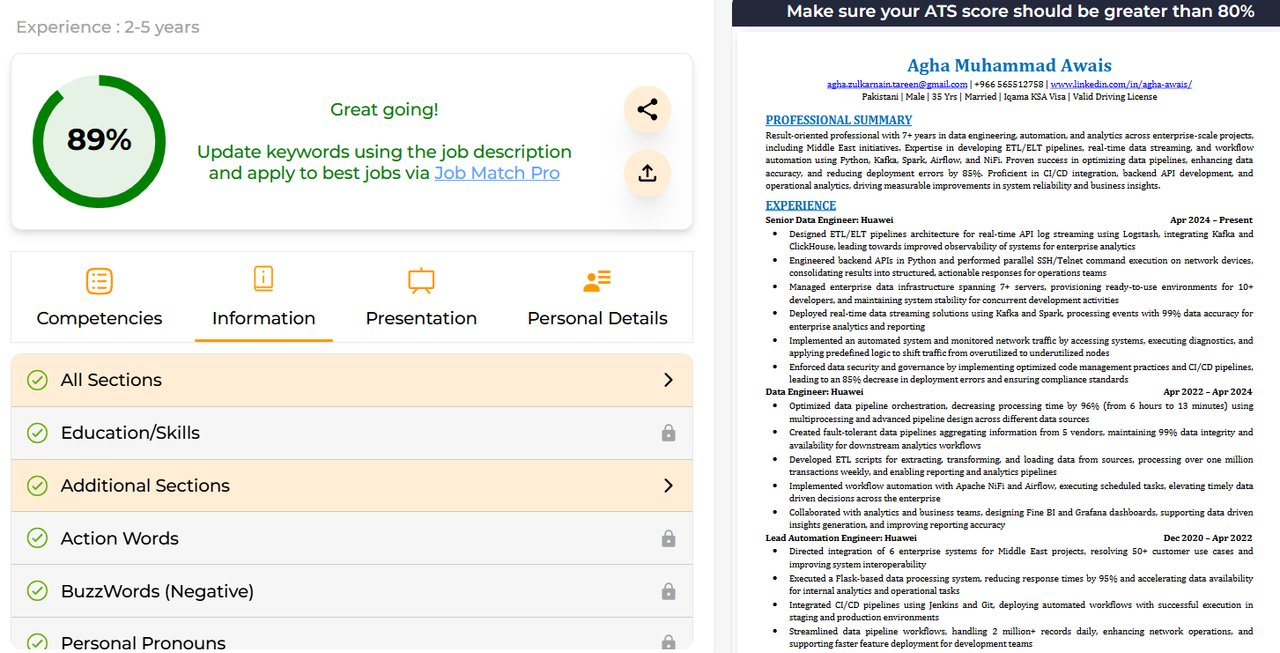
- Optimized keywords for job description
- Impactful, measurable achievements
- Clean, ATS-friendly formatting
Tips to Improve ATS Score
To improve your ATS score, tailor your resume with relevant keywords from the job description and use clear headings like “Work Experience” and “Skills.” Keep the format simple, preferably a clean single-column layout. You can also use ATS tools like ResuScan to analyze your resume and aim for a 75–80% match.
- Use relevant keywords: Choose the right resume keywords and match them with the job description. A good resume ATS score checker helps you identify which keywords are missing
- Keep it simple: Avoid complex formatting, graphics, or unusual fonts. Clean resumes perform better when you check ATS score of resume
- Use standard headings: Stick to clear headings like Experience, Education, and Skills so the ATS can easily understand your resume structure
- Customize for each job: Don’t send the same resume everywhere. Tailor your resume for every role to improve results when you use an ATS score checker free
- Proofread your resume: Spelling and grammar mistakes reduce your ATS score and create a poor impression
When you consistently check ATS score, these small improvements add up and help you reach a stronger score over time.

Effect of ATS Resume Scanners on Job Application Success
ATS resume scanners significantly impact job application success by acting as the first screening step before recruiters review candidates. They evaluate resumes for keyword relevance, formatting, and job fit, often filtering out applicants early. As a result, many candidates are rejected not for lack of skills, but due to poor ATS optimization.
- Your resume gets seen (or ignored): If you don’t check ATS score, your resume might never reach a recruiter, no matter how good your experience is
- Shortlisting depends on matching: ATS looks for relevance. When you check ATS score of resume, you can clearly see how well you match the job on resume shortlisting software
- Better alignment with job roles: Instead of applying randomly, using an ATS score checker free helps you tailor your resume for specific roles
- Less guesswork in applications: You’re not relying on assumptions anymore. A resume ATS score checker shows what’s working and what’s not
- Faster movement in hiring process: Resumes that are properly optimized tend to move ahead quicker compared to unoptimized ones
That’s why taking a few minutes to check ATS score can directly improve how often you hear back from employers.
Key Takeaways
This section gives you a clear direction on what to actually do after learning how to check ATS score. It’s about applying smarter, not just more.
In real job searches, small improvements in your resume can lead to better responses and more interviews.
- Always check ATS score before applying so you know where your resume stands
- Use an ATS score checker free tool to quickly identify gaps and issues
- Aim for an 80%+ ATS score of resume for better shortlisting chances
- Focus on adding job-specific keywords instead of using generic content
- Keep your resume format simple so ATS systems can read it easily
- Customize your resume for each job instead of sending the same version everywhere
- Use a resume ATS score checker regularly to track improvements
- Fix small issues like formatting, repetition, and missing sections before applying
When you follow this consistently, your applications become stronger and more targeted.
Over time, this approach helps you get more callbacks without increasing the number of applications.
How do I check my ATS score for free?
You can get instant feedback by uploading your resume in PDF or DOCX format to free tools like ResuScan. It looks at over 40 different factors, from formatting and content to readability and keyword use.
How to check your ATS score:
- Prepare your resume: Make sure it’s in a standard format like PDF or DOCX.
- Upload to ResuScan: You get a free resume review along with your ATS score.
- Review the report: The tool highlights mistakes and areas that need improvement.
- Optimize: Fix gaps in keywords, layout, and content based on the suggestions.
Why use ResuScan:
- Evaluates 40+ key factors in your resume
- Shows exactly which areas need improvement
- Offers keyword optimization guidance to improve ATS compatibility
What is a good ATS score for getting a job?
Why is my resume getting rejected by ATS?
Do ATS systems reject resumes automatically?
How do I optimize my resume for ATS?

Got Your Answer ?
Learn this in 30 Seconds 👇

Career Blogs
Our career blog is your go-to resource for insightful advice, practical tips, and the latest trends in the job market.







Office Address: Room No 305, IIT ROPAR-TBIF, Top Floor (East Wing), M.Visvesvaraya, Rupnagar PB, 140001
- Free Online Resume Review
- Check Resume Score
- Job Description Keyword Finder
- Resume Shortlisting Software
- Resume Scanner for Jobs
- Find jobs that match with resume
- Job matching platform
- Resume job matching
- Job suggestion
- Best sites to find jobs
- Free ats resume scanner
- Auto apply for job
- Full Time Jobs
- I Need a Job
- Information Technology Jobs
Can't Find Something? Get in Touch.
©2026 Padhakku Peek A Book Pvt Ltd (Mployee.me)


