

We'll cover
Top Ways to Land Remote Jobs in 2026
Written by Palak Jain

- Remote work grows due to flexibility, trust, and global hiring
- Tech, marketing, writing, and support dominate remote roles.
- Strong communication and time management boost remote job success.
- ATS-optimized resumes increase shortlisting chances significantly.
- Smart platforms and tailored applications beat mass applying.
We'll cover:
Why Remote Jobs Are Still Growing in 2026?
Remote work is growing in 2026 because companies and employees have understood that not all work requires a physical office. In the past few years, companies tested working from a distance as a mass experiment and found that it was more successful than they expected. Remote work has now turned from a temporary solution to a permanent solution.
- Companies Can Hire Talent from Anywhere: In the past, a company was restricted in its recruitment process in terms of the candidate residing in the vicinity of the company’s office. Nowadays, this is not a problem anymore. Organizations can hire the best professionals from other cities or even foreign nations.
- Technology Makes Remote Work Easy: Technology has made remote jobs or collaborative working easy and efficient. Teleconferencing tools, sharing documents, project management tools, as well as cloud storage services make collaboration easy for workers. The staff are able to share information, even solve problems, through the technological systems available without having to physically meet with the higher employer.
- Better Work-Life Balance for Employees: Professionals prefer working from home since this type of work saves their time, thereby removing daily stress through their daily stress removing routing. Remote jobs also enable individuals to dedicate sufficient time to family, concentrate better, and adopt fit routines. Happy workers usually perform better, hence benefiting organizations as well.
- Cost Savings for Everyone: Remote Jobs allows businesses to save on office space, utility, and maintenance. At the same time, the employee will also be able to save on transportation, meals, and moving. This makes telecommuting an attractive alternative on both fronts.
- Shift Toward Hybrid and Flexible Work Models: Instead of office hours, flexible or hybrid working hours are slowly being offered in companies on best sites to find jobs. The effect of this on workers is that they are now in a position to manage their lives. Remote jobs are hence increasingly being promoted across various sectors.
- Proven Productivity and Trust: Many firms have come to a point where they realize that the productivity of employees is the same or even better when an employee works from home. The trust between employers and employees has improved since employees are also happy to work from home and spend much time with their families, which will enable the firms to provide jobs for working from home in the year 2026.
Because remote work benefits both companies and employees through flexibility, productivity, cost savings, and access to global talent, it has become a long-term work model that will continue to grow throughout 2026 and beyond.
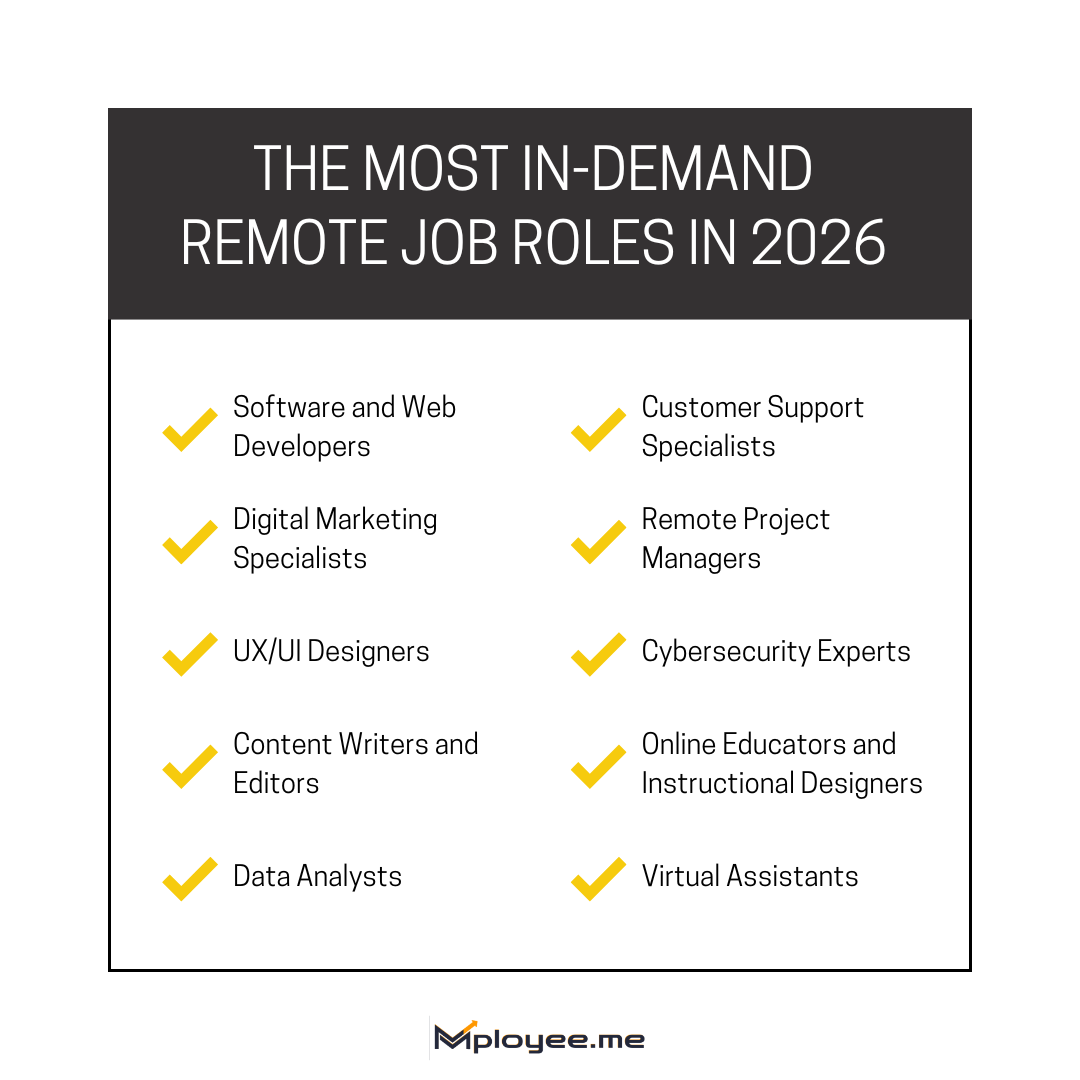
The Most In-Demand Remote Job Roles in 2026
In 2026, telecommuting job openings are available across a variety of sectors, and certain jobs are more in demand because they are fully convertible over the Internet and are skills-based.
1) Software and Web Developers: Software developers and web developers design websites, applications, as well as software. Programming only needs a computer as well as internet accessibility. Therefore, programmers are in demand as some of the best employees. People are needed by companies to work from home, solve problems, as well as complete deadlines.
2) Digital Marketing Specialists: Digital marketers assist businesses in growing their online presence via social sites, search engines, emails, and ads. Since all the operations happen online—planning, executing, as well as reporting—this job is the best fit for remote employment.
3) UX/UI Designers: UX/UI designers are concerned ,how a software icon or all other content look and feel of websites and apps are attractive to the customers. They work to provide useful layouts and enhance the user experience. Their tasks range from research to design to feedback, which can be done from a distance.
4) Content Writers and Editors: Content writers write and produce blog posts, website content, emails, and marketing materials. Editors refine and improve content quality. Since writing and editing require focus rather than physical presence, these roles are highly remote-friendly.
5) Data Analysts: Data analysts analyze data for companies in order for the companies to make informed decisions. Data analysts use data tools, data dashboards, and data reports. Data analysts can provide information for a company because the information is available online, which allows data analysts to work for a company from a distance.
6) Customer Support Specialists: Many organizations offer customer services through chat or email/phone calls from distant locations. Customer services providers assist clients in solving their issues or clarifying their queries without the need for an office environment.
7) Remote Project Managers: Offsite project managers use online tools to plan projects, manage time, and work with teams. Project managers make sure projects follow the timeline schedule to ensure efficiency of communication among the team members.
8) Cybersecurity Experts: Most of the businesses transitioning to the online platform, there has been a need to protect their cyber infrastructure. The process of analysis of threats, protecting information, as well as the prevention of cyber attacks, has conventionally required a physical office setup.
9) Online Educators and Instructional Designers: Online tutors and course developers develop and implement learning programs through online platforms. Because of the growing interest in online learning, such professionals are also increasing.
10) Virtual Assistants: Virtual assistants support businesses in appointment scheduling, email management, data entry, and many other office-related tasks. Since the nature of the tasks involves the use of technology, they can be carried out in a remote setting.
Businesses are interested in jobs where employees are measured based not on physical presence but results.
Skills You Must Have to Get a Remote Job in 2026
Listed below are the skills required for a remote job candidate. These skills should be acquired by all remote job seekers:
- Communication Skills: When it comes to remote jobs, most of the communication required is feasible through emails, chitchat sessions, or video conferencing tools. There is no scope for an informal discussion in the background of the office environment, so you just need to get your point across with a clear explanation of the concepts you introduce through questioning or updates.
- Time Management: Working from home is flexible; however, the aspect of working from home requires discipline. As a matter of fact, you need to learn how to handle time effectively when you're working from home because you need to prioritize, meet deadlines, and avoid any form of distraction. Such is the kind of employee that employers need.
- Technical and Tool Knowledge: Remote workers are expected to be comfortable using digital tools. This includes:
- Video meeting tools (Zoom, Google Meet)
- Team communication apps (Slack, Microsoft Teams)
- Task management tools (Trello, Asana, Notion)
- Cloud tools (Google Drive, Dropbox)
- Adaptability and Flexibility: Remote jobs tend to be working in other time zones, as well as switching to the new technologies and understanding tools processes. Employers would prefer to hire people who easily adjust to different processes and systems.
- Digital Collaboration: Telecommuting does not mean working alone but rather being able to work in teams by using all of the above-mentioned skills in document sharing, comments, progress information, and respecting deadlines while working in teams without being in the same physical location.
- Continuous Learning: Technology and types of jobs are changing rapidly. What the employer finds attractive in a candidate is the ability to upgrade his learning skills by taking online courses and certifications.
- Self-Motivation and Accountability: Remote work requires trust. Employers look for people who can take initiative in their work, remain concentrated, and perform their duties honestly. Self-motivated people are the best assets for telecommuting.
Mastering these remote-ready skills will help you stay productive, trusted, and competitive in the global job market of 2026.
How to Build a Remote-Ready Resume That Gets Shortlisted?
Think of your resume as your first way to make a perfect positive impression. It must communicate clarity, relevance, and impact.
Remote Resume Essentials:
- Professional summary: Include telecommuting skills, productivity techniques, and use of computer tools.
- Relevant achievements: Include remote successes or measurable results.
- Technical tools: List platforms and tools that demonstrate readiness for virtual work environments.
To further fine-tune your resume, use ResuScan. Here’s how it helps:
- ATS resume checker: Evaluates your resume against ATS standards and proposes easy changes to enhance both the formatting and content.
- Comprehensive resume analysis: Examines your resume in terms of 40+ factors like layout, language, and keywords so as to increase the likelihood of you being short-listed.
- Detailed feedback: Finds resume errors and employs evaluation to demonstrate precisely what requires improvement.
- Free initial review: Provides you with a free ATS resume scanner score that allows you to easily determine the strength of your resume and what needs to be fixed.
- Keyword optimization: Recommends missing keywords from the job posting that could be helpful in making your resume fit for the roles and passing the ATS screening.
Here’s how to use ResuScan:
Step 1: Upload Your Resume in PDF Format

Step 2: Add Your Total Years of Experience

Step 3: Wait 30 Seconds for Results

Optimizing Your LinkedIn Profile for Remote Hiring Managers
LinkedIn is much more than an online CV. It's your digital professional world. If you are likely looking for telecommute work, you have to work on your profile so that job-screening panels understand that you are prepared for telecommute work.
LinkedIn Hacks for Remote Job Seekers:
- LinkedIn profile picture: Professional picture and headshot that incorporate the use of remote technical terms.
- About section: Write a compelling summary highlighting your career goals and remote competencies.
- Featured section: Add portfolio links, presentations, or articles you’ve written.
- Skills & endorsements: When you talk to your digital and remote working skills.
- Recommendations: Ask for new recommendations from seniors who are already working virtual at their job.
An optimized profile will make you searchable via remote job search terms by recruiters.
Where to Find Remote Jobs: Best Platforms in 2026
Getting a telecommuting job requires knowing where to find jobs. There are several sites available as of 2026 where telecommuting jobs can be found. You won’t find every job in the same spot. Some pop up on big job matching platforms, others hide out on company websites, and sometimes you’ll hear about a role through someone you know. Here is an amazing platform which can help you land your dream job through resume job matching: Job Match Pro.
- Everything in one place: You don’t need to go on different job boards for job openings like LinkedIn, Naukri, or Foundit. Just upload your resume and details once, and the tool searches all these major platforms to find the right jobs for you with matching scores.
- Only new openings: Stop applying to jobs that were posted weeks ago. Job Match Pro only shows you active jobs posted in the last 24 to 48 hours, so your application is always the first for the hiring team.
- Check your match score: For every job it finds, you get a "Match Score", It means this tells you instantly how well your profile fits the role, so you don't waste time applying to the wrong jobs applications.
The use of Job Match Pro helps in time-saving, gives less pressure, and leads introverts gradually to find low interaction careers.
Here’s how to use Job Match Pro:
Step 1: Upload Your Resume

Step 2: Choose Preferences

Step 3: Add Skills and Keywords

Step 4: Go Through The List of Jobs

How to Apply Smartly for Remote Jobs?
Searching for a job from a distance requires more than just applying your resume to as many companies as possible. It means searching for a job search, where you get noticed by a recruiter, applies to people looking to remote jobs. Since many people are looking for work from home jobs, a little finesse in how you are applying will work wonders for you.
Application Best Practices:
- Customize your application: Take the time to tweak them for each job. Show them you actually read the JD and that you’ve got what they’re looking for, so that each and every time you modify their resume for alignment.
- Highlight remote strengths: Emphasize your personal "remote" strengths, such as work done independently, across-time-zone collaboration, or other things.
- Use multiple platforms: Apply using the company official websites, job boards, and professional networks.
- Network: Connect with recruiters and employees within remote-friendly companies.
Keep in mind don’t lose track of where you’ve applied. Always track your applications.
How to Prepare for Remote Job Interviews in 2026?
Remote interviews aren’t quite like the old in-person ones. They run on their own rules, with different tools and own dynamics and expectations.
Interview Preparation Guide:
- Technical setup: When you connect virtually, and make sure to check the webcam, microphone, and internet connection prior to taking part.
- Professional background: Pick a spot that looks tidy and keeps noise out.
- Practice video etiquette: Use eye contact, speak audibly, and project confidence with the other employer.
- Prepare remote-specific answers: Interviews may include questions about handling time management, working with others, or tool preferences.
Go through common remote interview questions and prepare them.
Common Mistakes That Stop People from Getting Remote Jobs
Many candidates miss out on remote roles due to avoidable errors. These mistakes often signal to recruiters that a candidate is not fully remote-ready.
Mistake 1: Using a Generic Resume
A one-size-fits-all resume fails to show your suitability for remote work.
Do: Tailor your resume to highlight remote skills and tools.
Don’t: Send the same resume to every remote job.
Mistake 2: Ignoring Remote Job Keywords
Missing the right keywords can cause your resume to be rejected by ATS.
Do: Use keywords directly from the remote job description.
Don't: Skip keyword optimization for remote roles.
Mistake 3: Poor Communication Skills
Remote roles depend heavily on clear and consistent communication.
Do: Show strong written communication in your resume and emails.
Don’t: Use vague or unclear language when applying.
Mistake 4: Not Showing Remote Readiness
Employers want proof that you can work independently.
Do: Mention time management and self-discipline skills.
Don't: Assume recruiters will infer your remote capability.
Mistake 5: Applying Without Research
Lack of company knowledge signals low interest.
Do: Research the company and role before applying.
Don’t: Apply blindly without understanding remote expectations.
How Freshers and Career Switchers Can Get Remote Jobs?
Remote jobs aren’t only for experienced professionals. Even freshers with the right strategy, and career switchers can also get a shot, too.
Tips for Beginners:
- Start with internships or short contracts: They’ll give you hands-on experience then your resume considerable for employers.
- Build a portfolio: Projects, case studies, and real-life results speak louder than words.
- Upskill: Courses, certifications, and online classes enhance your profile.
- Volunteer or freelancing gigs: They can replace professional experience on your resume.
Try to do freelance or volunteer types work. These gigs are on your resume and show you know how to get things done.
Avoid Scams and Find Legitimate Remote Jobs
With remote work’s popularity, scams and fake listings have also increased.
How to Spot Legit Jobs:
- Professional listings: Legitimate jobs rarely have poor grammar or unrealistic promises.
- Verified company websites: Check the company’s official site and career page.
- No upfront payment: Reputable employers won’t ask for fees or investments.
- Clear job descriptions: Legit roles have defined responsibilities, skills required, and realistic compensation.
Trust your instincts. If something feels off, research before applying.
Key Takeaways
In the year 2026, remote jobs will be available to the masses more than ever before, but the successful ones will be the ones that work out a perfect strategy combined with the right skills and thorough preparation.
- The remote work trend is a constant due to its advantages in terms of flexibility, productivity, and cost.
- Technical, marketing, design, data, and support professions are the main ones that contribute to remote hiring.
- Apart from strong communication, time management and digital skills are also important.
- Remote-ready resumes and ATS optimization increase the chances of being shortlisted.
- Optimized LinkedIn profiles make the recruiters find remote job candidates easily.
- Intelligent platforms and job suggestion tools not only save time but also make sure your profile fits the role perfectly.
- Customized job applications are always the winners over mass and generic submissions.
- It is very important to be aware of scams when applying for remote positions.
If you possess the right approach, tools, and mindset, then getting a remote job in 2026 is going to be very easy.
How to quickly land a remote job?
To land a remote job faster, focus on quality, not quantity. Update your resume to show skills like communication, time management, and remote tools. Apply only to roles that match your skills, customize each application, and use trusted job platforms. Keeping your LinkedIn profile updated also helps recruiters find you sooner.
What is the easiest remote job to land?
What jobs can I do fully remotely?
What is the best way to work remotely?
What is the most popular remote job?

Got Your Answer ?
Learn this in 30 Seconds 👇

Career Blogs
Our career blog is your go-to resource for insightful advice, practical tips, and the latest trends in the job market.







Office Address: Room No 305, IIT ROPAR-TBIF, Top Floor (East Wing), M.Visvesvaraya, Rupnagar PB, 140001
- Free Online Resume Review
- Check Resume Score
- Job Description Keyword Finder
- Resume Shortlisting Software
- Resume Scanner for Jobs
- Find jobs that match with resume
- Job matching platform
- Resume job matching
- Job suggestion
- Best sites to find jobs
- Free ats resume scanner
- Auto apply for job
- Full Time Jobs
- I Need a Job
- Information Technology Jobs
Can't Find Something? Get in Touch.
©2026 Padhakku Peek A Book Pvt Ltd (Mployee.me)


