

We'll cover
One-Page vs Two-Page Resumes: What’s Ideal for 2026?
Written by Palak Jain

- One-page resumes are usually the best choice for freshers, students, and early-career professionals because they keep the content clean, focused, and easy for recruiters to scan quickly.
- Two-page resumes are more suitable for mid-level and senior professionals who have multiple roles, projects, certifications, or measurable achievements that require additional space to present properly.
- The most important factor is not resume length but relevance and clarity, since recruiters prioritize strong achievements and role-specific content over how many pages the resume has.
- ATS systems can read both one-page and two-page resumes effectively as long as the formatting is simple, the headings are standard, and relevant keywords are included properly.
- Academic CVs are very different from resumes and can range from 3 to 10 pages because they include detailed sections like research work, publications, conferences, teaching experience, and academic achievements.
We'll cover:
One Page vs Two Page Resume: Simple Decision Rule
This is one of those questions where people look for a strict rule, but the better answer is more practical than that. A resume should not be one page just because someone on the internet said so. It should also not become two pages just because you want it to look “bigger.” The real decision comes down to whether your resume feels complete, relevant, and easy to read.
If your important information fits naturally on one page, that is a good sign. If you have to cut out meaningful work, strong achievements, or solid proof of impact just to stay on one page, then forcing it shorter does more harm than good. Recruiters are not counting pages for the sake of it. They are judging whether the content is worth their time.
Use a one-page resume if:
- you are a fresher, student, or early in your career
- you have less than 5 years of relevant experience
- your best skills, education, projects, and achievements can be shown properly on a single page
- adding a second page would only mean extra fluff, repeated points, or weak details that do not really improve your profile
Use a two-page resume if:
- you have 6 or more years of relevant experience
- you have grown through multiple roles, promotions, or responsibilities over time
- you have important projects, certifications, technical work, or measurable achievements that need space to be explained well
- cutting it down to one page would remove the strongest evidence of what you have actually done
How Long Should a Resume Be?
Resume length has always been the matter of confusion for the majority of job seekers. Some side for one page, whereas others for the two pages. The truth is it depends on the career stage one is and what attracts the recruiter to look for.
- Freshers / Students: One page is good since recruiters look at education, skills, and some project work.
- Early professionals (1-4 years): One page resume template is mostly sufficient unless you have had a considerable number of internships to report.
- Mid-level professionals (5-10 years): Two pages would be the perfect balance, really; one page is often just too short.
- Senior Professionals: Two pages provide enough room to show leadership, strategy, and impact clearly.
Resume Length Comparison Table (2026)
| Candidate Type | Recommended Resume Length | Why This Works |
|---|---|---|
| Freshers / Students | One page resume | Simple, easy to read, recruiter-friendly. |
| Early professionals (1–4 yrs) | One page resume template | Enough to show skills, projects, and impact. |
| Mid-level professionals (5–10 yrs) | Two page resume format | Room for growth, achievements, and results. |
| Senior leaders (10+ yrs) | Two page resume format | Balanced detail without overwhelming recruiters. |
| Academic or research profiles | CV (3–5+ resume pages) | Needed for publications, research, and detailed work. |
Recruiters do not count resume pages, but the value is considered. The right resume length expresses quality over quantity.
Should a Resume Be One Page?
In most cases, yes, a resume should be one page, especially if you are a fresher, early-career candidate, or have 5+ years of experience. A one-page resume usually works better because recruiters often scan resumes quickly and prefer something clear, focused, and easy to read. That said, one page is not a strict rule for every person or every situation. These points explain why one page often works better, especially for freshers and early-career candidates.
For Freshers
One page works best for freshers and early-career candidates because the resume stays sharper and more relevant.
For Readability
A shorter resume is easier for recruiters to scan during the first review.
For Stronger Content
One page forces you to remove weak, repeated, or less useful information so the strongest content stands out.
For the Ideal Length
If your experience can be explained clearly in one page, that is usually the better choice. A second page should only be used when it adds real value.
Why One Page Resumes Still Work
One page resumes have been popular for decades. It basically forces you to be succinct and direct. Recruiters love it for the following reasons:
- They can scan it in under 7 seconds.
- Only the most relevant achievements are displayed.
- It is devoid of fluff and deep storytelling.
One page resumes work best in these situations:
- You are a fresher or a student.
- You have less than five years of working experience.
- You are making a career change and want to highlight only transferable skills.
- You want to be kept short for the recruiter who is otherwise very busy.
One page resume templates indicate that you can organize information smartly. Rather than putting in everything you've ever done, you put in what matters for the current job.
Example: Imagine two people applying for a junior data analyst position. One sends a single-page resume featuring strong skills in Python, SQL, and Excel, along with one solid project that clearly shows relevant ability. The other sends a two-page resume filled with school projects, part-time jobs, and unrelated details that do not really support the role. Which one looks sharper? Usually, it is the one-page applicant. The shorter resume feels more focused, easier to scan, and more clearly aligned with what the employer is actually hiring for.
Can a Resume Be 2 Pages?
Yes, a resume can be 2 pages if you have enough relevant experience to justify it. A second page is usually fine for mid-level and senior professionals, technical candidates, researchers, or people with multiple strong roles, projects, and certifications. The real question is not “Is 2 pages allowed?” but “Does the second page actually add value?”
- Two pages are normal for experienced professionals - If you have several years of relevant work, multiple promotions, important projects, or leadership responsibilities, a second page is completely reasonable. Trying to squeeze all of that into one page can make the resume feel cramped and harder to read.
- A second page should contain useful information, not filler - It should add stronger experience, achievements, technical depth, certifications, or major projects. If page two is mostly empty, repetitive, or filled with weak details, it usually does more harm than good.
- Technical and specialised roles often need more space - In fields like IT, engineering, product, consulting, research, or data, candidates often need extra room to show projects, tools, systems, certifications, and measurable results. In those cases, two pages can feel much more natural.
- Recruiters do not reject a resume only because it is two pages - What matters more is whether the resume is clear, relevant, and easy to scan. A well-structured two-page resume is usually better than a crowded one-page version that hides important value.
- Freshers usually do not need two pages - If you are early in your career, one page is still the safer choice in most cases. A two-page resume works best when there is enough strong content to support it.
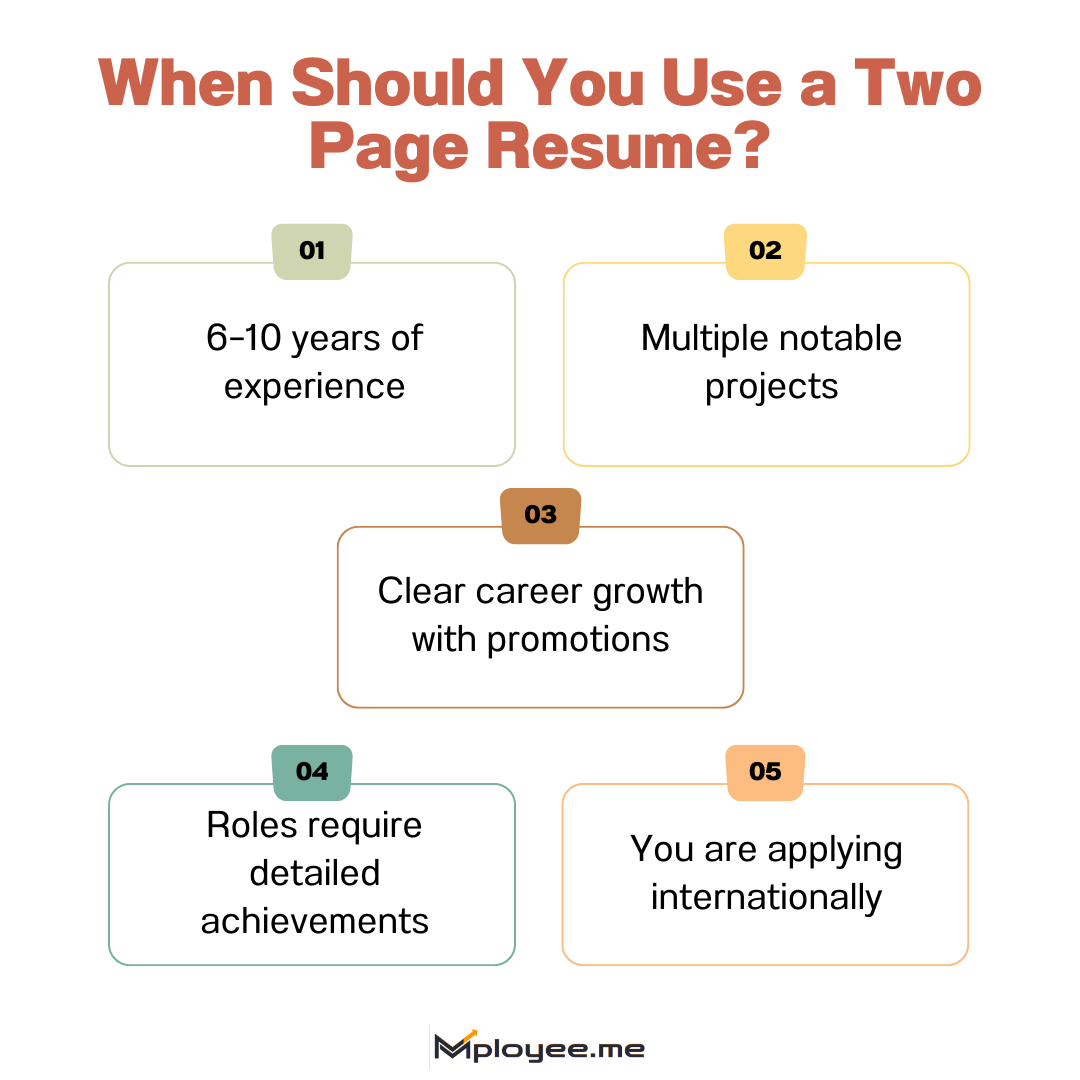
When Should You Use a Two Page Resume?
A two page resume is not necessarily a must, yet it turns out to be the very suitable choice as the career grows.
The two page resume becomes a good consideration when:
- You have experience for 5 or more years.
- Many projects worth showing detail for have been performed.
- There are many promotions to be shown as career growth.
- The detail matters as in IT, engineering, consulting, and project management.
- You are applying internationally (global recruiters generally would expect two resume pages).
In a usual setting, a two page resume allows enough room for leadership stories, big projects, list, and tangible achievements; however, recruiters do not want to read filler content. Only information that adds value should be included in a 2 page resume template.
Example: An 8-year-experienced software engineer with several certifications and some contributions to open source would be an incomplete story, had it been portrayed in a one page resume template. Here, the two page resume becomes essential.
Is a 2 Page Resume ATS Friendly?
Yes, a 2 page resume can absolutely be ATS friendly. The system does not reject a resume just because it goes to a second page. What matters much more is whether the resume is simple to read, easy to parse, and filled with relevant information. In real hiring, the bigger problem is usually not page count. It is messy formatting, weak keywords, and unnecessary filler that makes the resume harder for both ATS and recruiters to process.
- ATS cares more about format than length - A lot of people worry that two pages automatically confuse ATS, but that is usually not the real issue. The bigger issue is when the resume uses tables, graphics, icons, text boxes, or fancy layouts that make the content harder to read.
- Two pages are fine if the content actually deserves the space - If you have enough relevant experience, strong projects, certifications, or technical work to support a second page, then that is completely okay. A second page is not a problem when it adds real value instead of just stretching weak content.
- Keyword relevance still matters more than page count - A one-page resume with missing keywords can perform worse than a two-page resume that clearly matches the job description. ATS is mainly checking whether your resume contains the right terms, sections, and experience signals for the role.
- The second page should feel like continuation, not leftovers - Sometimes people add a second page but fill it with old, repeated, or low-value content. That is where the resume starts feeling weaker. If page two is there, it should continue the story of your profile in a useful way, not feel like extra material added just to use more space.
- Recruiters will still look at clarity first - Even if the ATS reads both pages properly, a recruiter will still judge whether the resume feels clean and worth reading. A sharp two-page resume usually works better than a cramped one-page version that hides useful achievements or makes everything too dense.
Want to Check If Your Resume Is ATS Friendly?
Before worrying too much about whether your resume should be one page or two pages, it helps to check whether it is actually ATS compatible. ResuScan scans your resume in around 6 seconds and gives a detailed ATS analysis based on 40+ factors.
It also shows what may be missing in your resume and gives suggestions to help you improve formatting, keyword relevance, structure, and overall ATS compatibility.
Can Freshers Use a 2 Page Resume?
No, freshers can’t use a 2 page resume in most cases. For the majority of freshers, a one-page resume is the better and safer choice because recruiters prefer something concise, clean, and easy to scan quickly. Since freshers usually have limited work experience, stretching the resume to two pages often adds filler instead of value. A second page only makes sense in rare cases where the candidate has multiple internships, strong academic projects, certifications, research work, or major achievements. Even then, the extra page should contain useful proof, not repeated content. In general, a strong one-page resume works better for freshers.
One Page vs Two Page Resume: Quick Comparison Table
| Factor | One Page Resume | Two Page Resume |
|---|---|---|
| Best for | Freshers, students, early-career professionals | Experienced professionals, technical roles, candidates with multiple internships/projects |
| Recruiter readability | Faster to scan | Works well if content is relevant and well-structured |
| Ideal experience level | 0–5 years | 5+ years or strong project-heavy profile |
| Content space | Limited, so only top highlights fit | More room for projects, achievements, certifications, and detailed experience |
| Best use case | Campus placements, entry-level jobs, internship applications | Mid-level roles, specialized jobs, research, consulting, technical profiles |
| Overall rule | Best when your profile can be explained clearly in one page | Best when the second page adds real value |
How Long Should a CV Be?
A CV is usually much longer than a resume. While a resume is typically one or two pages and gives a brief overview of your career, a CV is more detailed and is used mainly in academic, research, medical, and teaching fields. Its length depends on how much relevant information you need to include.
- A CV does not need to be one page - Unlike a resume, a CV can be 3, 5, or even 10 pages long if your background requires that much detail.
- A CV includes more detailed academic and professional information - It often covers education in depth, research work, publications, academic projects, conferences, certifications, awards, and teaching experience.
- Students and job seekers in regular company roles usually need a resume, not a CV - If you are applying for standard corporate jobs in 2026, a one-page or two-page resume is usually the better choice.
- Longer CVs are normal in academia and research - Professors, doctors, researchers, and scholars often use CVs that are 4 to 5 pages or longer because their work history is more detailed.
- Recruiters in companies usually prefer short, clear documents - For most private-sector jobs, employers prefer concise resumes instead of long CVs, while academic institutions are more open to detailed multi-page CVs.
How to Fit Everything on One Page Resume (with Template)
Making a one page resume work can be tricky. Tips:
- Cut out irrelevant jobs: Worked in a café during college? Omit that for an IT job application.
- Use bullet points: Don’t add long paragraphs.
- Show results, not duties: Instead of saying "Handled reports," say "Prepared weekly sales reports that improved efficiency by 20%."
- Put skills first: List 6 to 8 key skills relevant to the job description.
- Use space wisely: Do not stuff everything. A clean layout helps reading.
Use the right resume template: One page lets you put in only the essentials, which never look cluttered.
Experienced professional with 4+ years of experience in managing client accounts driving revenue growth strengthening relationships improving retention forecasting pipelines negotiating contracts coordinating stakeholders analysing performance metrics leading renewals upselling services resolving escalations delivering consistent value across SaaS education and enterprise portfolios achieving a 29% increase through structured planning communication cross functional collaboration data driven decisions customer advocacy and long term partnership ownership focused growth excellence delivery outcomes impact.
- Managed enterprise client portfolios overseeing renewals upsells escalations and negotiations while increasing annual account revenue by 33% through structured relationship management practices
- Collaborated with sales product and operations teams aligning expectations improving client satisfaction by 24% and ensuring consistent delivery across high value strategic accounts
- Analysed account performance metrics identifying expansion opportunities reducing churn risk and supporting long term growth planning through proactive engagement strategies
- Led quarterly business reviews translating client goals into execution roadmaps strengthening executive trust and improving renewal success across multiple key accounts
- Handled mid market client accounts managing renewals negotiations and service coordination improving customer retention by 27% through structured communication planning
- Acted as primary client contact resolving concerns aligning expectations and coordinating internal teams to ensure timely delivery and relationship stability
- Tracked pipeline revenue forecasts contract timelines and account health metrics supporting leadership decision making and accurate revenue planning initiatives
- Drove account expansion initiatives identifying upsell opportunities resulting in a 22% increase in recurring revenue across managed portfolios
- Supported senior account managers handling client communication onboarding documentation and coordination across active accounts ensuring smooth service delivery
- Monitored service delivery milestones reducing turnaround delays and improving operational efficiency by 23% through proactive follow ups
- Prepared account reports performance summaries and renewal insights supporting data driven discussions with internal and external stakeholders
- Maintained strong client relationships through regular engagement feedback collection and issue resolution support activities
- Handled client acquisition onboarding account coordination for education focused segments supporting senior managers with execution tasks
- Maintained CRM records follow up schedules and pipeline updates improving lead conversion rates by 18% through consistent tracking
- Built foundational account handling experience through direct client interaction relationship support and service coordination responsibilities
- Account Management
- Client Retention
- Renewal Strategy
- CRM Tools
- Contract Negotiation
- Relationship Building
- Account Analytics
- Upselling Strategy
- Risk Management
- Certified Account Manager – AAAM Mar 2024
- Strategic Account Management – Coursera Nov 2023
- CRM & Relationship Management – Udemy Aug 2022
- Improved key account retention through structured engagement planning and proactive renewal execution strategies
- Recognized for exceeding quarterly revenue targets through consistent upselling and client relationship management
How to Make Two Pages Resume Work (with Template)
A two page resume may very well be necessary, but it has to be properly constructed.
Some tips for a two page resume template:
- Page 1: Headline achievements, Top skills, Recent jobs
- Page 2: Older jobs, Certifications, or Projects
- Never repeat the same information on pages 1 and 2.
- Keep your formatting consistent.
Remember, recruiters read the entire first page carefully. The second page will only come into focus if the first page holds their attention.
Experienced professional with 4+ years of experience in managing client accounts driving revenue growth strengthening relationships improving retention forecasting pipelines negotiating contracts coordinating stakeholders analysing performance metrics leading renewals upselling services resolving escalations delivering consistent value across SaaS education and enterprise portfolios achieving a 29% increase through structured planning communication cross functional collaboration data driven decisions customer advocacy and long term partnership ownership focused growth excellence delivery outcomes impact.
- Managed enterprise client portfolios overseeing renewals upsells escalations and negotiations increasing annual account revenue by 33% through structured relationship management and long term engagement planning
- Collaborated with sales product and operations teams aligning expectations improving client satisfaction by 24% while ensuring consistent delivery across high value strategic enterprise accounts
- Analysed account performance metrics identifying expansion opportunities reducing churn risk and supporting long term growth planning through proactive engagement data analysis and stakeholder alignment
- Led quarterly business reviews translating client goals into execution roadmaps strengthening executive trust improving renewal outcomes and driving continued expansion across multiple key accounts
- Designed standardized account playbooks enabling consistent engagement cadence risk mitigation planning and scalable account handling frameworks across teams supporting predictable revenue performance outcomes
- Handled mid market client accounts managing renewals negotiations and service coordination improving customer retention by 27% through structured communication planning and proactive relationship management
- Acted as primary client contact resolving concerns aligning expectations and coordinating internal teams to ensure timely delivery service consistency and strong long term relationship stability
- Tracked pipeline revenue forecasts contract timelines and account health metrics supporting leadership decision making accurate revenue planning and improved visibility across active client portfolios
- Implemented periodic account health reviews identifying early risk indicators enabling corrective actions proactive engagement and stronger long term account stability across assigned client portfolios
- Supported senior account managers handling client communication onboarding documentation and coordination across active accounts ensuring smooth service delivery and positive client experience outcomes
- Monitored service delivery milestones reducing turnaround delays and improving operational efficiency by 23% through proactive follow ups coordination and cross functional task tracking
- Prepared account reports performance summaries and renewal insights supporting data driven discussions with internal leadership teams and external client stakeholders regularly
- Maintained strong client relationships through regular engagement feedback collection and issue resolution support activities ensuring service continuity and long term account trust
- Handled client acquisition onboarding and account coordination for education focused segments supporting senior managers with execution tasks and early stage relationship management
- Maintained CRM records follow up schedules and pipeline updates improving lead conversion rates by 18% through consistent tracking data accuracy and timely outreach
- Supported proposal preparation pricing coordination and client communication throughout multiple concurrent sales cycles ensuring clarity alignment and timely deal progression
- Built foundational account handling experience through direct client interaction relationship support and service coordination responsibilities across multiple active education clients
- Account Management
- Client Retention
- Revenue Growth
- Renewal Strategy
- CRM Tools
- Contract Negotiation
- Pipeline Tracking
- Relationship Building
- Account Analytics
- Upselling Strategy
- Business Reviews
- Risk Management
- Designed structured account growth frameworks mapping client goals expansion signals and renewal timelines improving enterprise revenue predictability and achieving 31% portfolio growth
- Collaborated with sales product and leadership teams aligning expansion strategies and execution plans ensuring consistent delivery across multiple high value enterprise accounts
- Built performance dashboards tracking account health engagement cadence and renewal risks enabling proactive decision making and stronger long term client relationships
- Led cross functional initiative redesigning renewal workflows communication cadence and escalation processes resulting in 26% improvement in client retention outcomes
- Analysed churn drivers contract timelines and satisfaction metrics developing early risk indicators to support proactive engagement and renewal readiness planning
- Standardized quarterly review templates aligning client objectives performance insights and future roadmap discussions strengthening trust and renewal success consistency
- Certified Account Manager – AAAM Mar 2024
- Strategic Account Management – Coursera Nov 2023
- CRM & Relationship Management – Udemy Aug 2022
- Improved key account retention through structured engagement planning and proactive renewal execution strategies
- Recognized for exceeding quarterly revenue targets through consistent upselling and client relationship management
- Received Star Performer Award for outstanding account ownership delivery consistency and revenue impact
- Earned client appreciation for proactive communication issue resolution and sustained long term relationship excellence
Key Takeaways
This would seem a very important thing to know: choosing one page or two pages for the resume according to situations. So here is a crisp resume length 2026 summary:
- A one page resume works well for freshers, students, and professionals with less than five years' worth of experience.
- A one page resume forces a focus on the most significant achievements and keeps recruiters from reading a lot of irrelevant extra information.
- A format should follow one page resume templates with a clean, concise, and recruiter-friendly layout.
- Generally, a two page resume is good for the mid-level executive-to-senior level executive having quite a few projects, promotions, or leadership experiences.
- Two page resume format offers the opportunity to present achievements, detailed projects, and quantifiable results without cluttering.
- The number of pages on a resume is less relevant than clarity of thought, impactfulness of texts, and relevancy to the job applied for.
- Recruiters start to look at resume length if it either is too short to show skills or too long to read quickly.
- One page or two page resume does not matter to an ATS; it's the formatting and the keywords.
- ResuScan will enhance your resume pages for ATS compatibility, highlight errors, and increase your resume score.
- A CV can span anywhere between three to ten pages of a resume; however, for most jobs, one should stick to a one page resume template or two page resume format.
The best kind of resume length is one that clearly conveys your story, highlights what you are good at, and speaks to the job for which you are applying-one page or two page resume.
Should a CV be one page?
A CV does not always need to be one page because it is different from a resume. A resume is brief and role-focused, while a CV can be longer and more detailed, especially in academic, research, medical, or international applications. The length depends on purpose, industry, and how much relevant experience you need to show.
Can a resume be 2 pages?
Is a 2 page resume ATS friendly?
Is a one-page resume better than a two-page resume?
How should my CV look in 2026?

Got Your Answer ?
Learn this in 30 Seconds 👇

Career Blogs
Our career blog is your go-to resource for insightful advice, practical tips, and the latest trends in the job market.






Office Address: Room No 305, IIT ROPAR-TBIF, Top Floor (East Wing), M.Visvesvaraya, Rupnagar PB, 140001
- Free Online Resume Review
- Check Resume Score
- Job Description Keyword Finder
- Resume Shortlisting Software
- Resume Scanner for Jobs
- Find jobs that match with resume
- Job matching platform
- Resume job matching
- Job suggestion
- Best sites to find jobs
- Free ats resume scanner
- Auto apply for job
- Full Time Jobs
- I Need a Job
- Information Technology Jobs
Can't Find Something? Get in Touch.
©2026 Padhakku Peek A Book Pvt Ltd (Mployee.me)


