

We'll cover
Do You Need a Photo on Your Resume? Country-Wise Resume Rules
Written by Jatin Batra

- A resume photo is not required for most jobs and is often avoided unless the role or country specifically expects it
- Photos are usually not ATS-friendly because applicant tracking systems are designed to read text, not images or graphics
- Countries follow different resume photo rules, so whether you should add one depends on local hiring culture and job type
- In India and many modern corporate roles, a no-photo resume is usually the safer and more professional choice
- If a photo is needed, use a formal outfit, clean background, clear image quality, and avoid selfies or heavy editing
We'll cover:
Should I add a photo in my resume?
Whether you should add a photo to your resume depends mainly on the country and sometimes on the type of role you are applying for. In some countries and customer-facing jobs, a photo may be acceptable or even expected. In other places, especially for standard corporate roles, it is usually unnecessary. If you are applying in India, adding a photo is generally not advisable for most jobs. Recruiters usually focus more on your skills, experience, and how well your resume matches the role. For most applicants, a clean resume without a photo is the safer and more professional choice.
Country-Wise Resume Photo Rules
Whether you should add a photo to your resume depends a lot on the country where you are applying. In some places, it is still common. In others, it is better to leave it out completely. That is why one resume rule does not work everywhere. It is always safer to follow local hiring practice instead of copying a template from the internet.
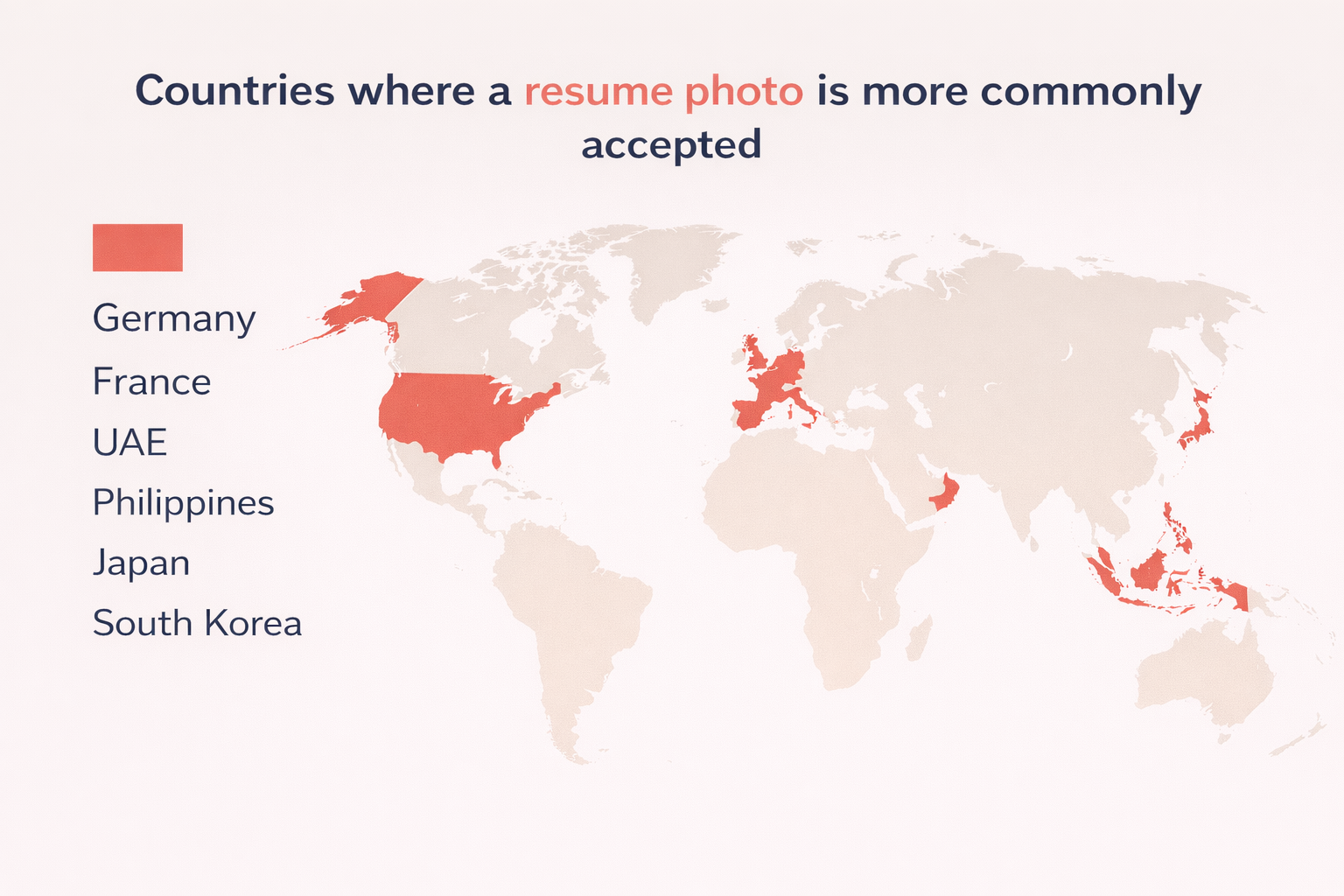
- United States, United Kingdom, Canada, and Australia - In these countries, photos are usually not recommended on resumes. Employers often prefer resumes without pictures because hiring is expected to stay focused on skills, experience, and qualifications rather than appearance.
- India, Singapore, and many Gulf countries - In these regions, adding a photo is usually optional, not compulsory. For most corporate jobs, a photo is not needed, but some people still include one for customer-facing or public-facing roles.
- Germany, France, and some other European countries - In parts of Europe, resume photos are still more common than in English-speaking countries, although this is changing slowly. Some employers may not mind a photo, but many modern applicants now choose simpler resumes without one.
- Japan, South Korea, and a few Asian job markets - In some of these countries, photos are more traditionally expected, especially for formal applications. In such cases, the photo is usually professional, passport-style, and placed neatly without affecting the rest of the resume.
- Best rule if you are unsure - If the company has not asked for a photo and the country does not strongly expect one, it is usually safer to leave it out. A clean resume with strong content is more useful than adding a picture just because a template shows one.
Is Resume Photo ATS-Friendly?
No, resume photos are generally not ATS-friendly because most systems cannot read images. Many applicant tracking systems are built to read text, section headings, and keywords, not images. A photo may not always break the resume, but it usually does not help and can sometimes create unnecessary risk.
- ATS does not need your photo to evaluate your resume - An ATS mainly checks your text, such as your job title, skills, work experience, and keywords from the job description. Your photo does not improve your match for the role.
- Images can sometimes affect resume parsing - If the resume layout is already complex, adding a photo can make the file harder for some systems to read properly. This is especially true when the image is placed inside a design-heavy template.
- Most recruiters care more about relevance than appearance - For most jobs, employers want to quickly see your experience, skills, and achievements. A photo usually takes up space that could be used for stronger content.
- In some countries, photos are not preferred on resumes - In many hiring markets, especially for standard corporate roles, resumes without photos are considered more professional and safer from a hiring-bias point of view.
- A simple resume without a photo is usually the better choice - If your goal is to make your resume more ATS-friendly, focus on clear formatting, job-specific keywords, and strong experience points instead of adding a picture.
When Is a Resume Photo Acceptable?
A photo is acceptable on a resume only in certain situations. For most jobs, especially corporate and ATS-based roles, it is usually better to leave it out. But there are some cases where a photo can make sense, depending on the industry, country, and what the employer expects.
| Situation | What It Means for Your Resume Photo |
|---|---|
| Appearance-based or public-facing roles | A photo is more acceptable for jobs like modelling, acting, media, hospitality, aviation, front desk, or customer-facing roles where presentation may influence hiring. |
| Country-specific hiring culture | In some countries, resume photos are more common than in others, so adding one may feel normal if local hiring practice generally accepts it. |
| Employer clearly asks for a photo | If the job posting specifically asks for a photo, passport-size image, or profile picture, adding one is appropriate because you are following the application requirement. |
| Professional photo that fits the layout | If you include a photo, it should look formal, clear, and simple. Avoid casual selfies, heavy filters, or oversized images that make the resume look less professional. |
| Non-ATS-heavy or direct applications | For less ATS-dependent hiring, especially local or direct applications, a photo may be more acceptable. For most finance, tech, analyst, legal, and office roles, it usually adds little value. |
When Should You Avoid a Resume Photo?
In many cases, leaving the photo out is the better decision. A resume is mainly meant to show your skills, experience, and fit for the job. If a photo does not help that, it can become a distraction or even work against you, especially in formal or ATS-based hiring.
- Avoid it for most corporate and office jobs - If you are applying for roles in finance, IT, HR, operations, legal, marketing, analytics, or administration, a photo usually adds no value. Recruiters in these fields care far more about your background than your appearance.
- Avoid it when applying through ATS-heavy systems - Many company portals and applicant tracking systems are built to read text, not images. A photo may not always cause a problem, but it does nothing to improve your ATS match and can make a resume feel less clean.
- Avoid it when the employer has not asked for one - If the job description says nothing about a photo, there is usually no reason to add it. In most cases, it is safer to follow a simple, standard format than to include extra elements on your own.
- Avoid it when space on the resume is limited - Resume space is valuable. That top section is better used for your name, contact details, skills, tools, or achievements instead of a picture that does not strengthen your application.
- Avoid it in countries where no-photo resumes are preferred - In places like the US, UK, Canada, and Australia, resume photos are generally discouraged. Even in countries where photos are sometimes seen, they are still not necessary for most standard professional roles.
Common Myths About Resume Photos
Where you place a photo on your resume matters if you decide to use one. The most common spot is the top corner, usually on the right side near your name and contact details. It should be small, professional, and should not disturb the layout. The photo should never take attention away from your experience, skills, or qualifications. Avoid placing it in the middle of the page or inside important sections like work experience or education. For most jobs, especially ATS-based roles, it is usually better to skip the photo completely. If you do include one, keep the resume neat and balanced.
| ❌ Myth | ✅ Reality |
|---|---|
| Adding a photo increases your chances | Hiring managers focus more on qualifications and relevance |
| A photo makes your resume more impressive | Many recruiters see it as unnecessary information |
| Photos are expected in all resumes | Only some roles or countries prefer them |
| A photo improves first impression | A clean, simple resume looks more professional |
| Appearance matters as much as skills | Hiring decisions are based on skills and job fit |
Do Recruiters in India Prefer a Resume With a Photo?
In India, most hiring managers do not treat a photo as an important part of the resume. For regular private-sector jobs, they usually focus more on your skills, experience, education, and whether your profile matches the role. A photo may not always be a problem, but in most cases, it does not add much value either.
Not a deciding factor
For most corporate jobs, hiring managers care much more about your qualifications and experience than your appearance.
Often seen as unnecessary
A resume photo usually does not improve your chances, so some recruiters may see it as extra information they did not need.
More acceptable in public-facing roles
In hospitality, aviation, front office, or media roles, a photo may feel more normal, depending on the employer.
No-photo resumes often look cleaner
A simple resume without a photo usually feels more professional and avoids making the layout look crowded.
What Background Color Is Recommended for a Resume Photo?
The best background for a resume photo is usually a plain white or light neutral shade. The reason is simple: it looks clean, professional, and does not steal attention from your face. A resume photo should feel formal and tidy, so the background needs to stay in the background, not become a noticeable part of the image.
- White is the safest and most accepted option - If you want the easiest choice, go with white. It looks formal, works across most industries, and fits well with almost every resume design.
- Light grey is also a good professional choice - Some people feel that bright white can look a little harsh. In that case, a soft grey background can still look polished without making the photo feel too sharp.
- Plain neutral shades work better than decorative ones - Off-white, beige, or very light grey can work well because they keep the image simple. The idea is to make the photo look neat, not stylish or dramatic.
- Avoid bright, dark, or distracting backgrounds - Strong colors like red, blue, green, or black can make the photo feel less formal. Busy walls, outdoor scenery, or patterned backgrounds can make it look even more casual.
- The background should support a professional look, not compete with it - When someone looks at the photo, their attention should stay on you, not on the wall behind you. That is why simple backgrounds almost always work better for resume photos.
What Is the Best Size and Resolution for a Resume Photo?
A resume photo should be small enough to fit neatly on the page, but clear enough to look professional. The photo is not supposed to dominate the resume. It should simply sit there quietly, while your skills and experience remain the main focus.
- Best photo size is usually small and passport-style - A good resume photo is often around 1.2 x 1.5 inches to 1.5 x 2 inches. In simple terms, it should show your face clearly without taking up too much space on the page.
- Use a clear head-and-shoulders crop - The photo should usually include your head and upper shoulders, not a full-body picture. This keeps it formal and helps it fit naturally into the top corner of the resume.
- Keep the resolution sharp, but not too heavy - A resolution of around 300 DPI is usually considered good for a professional-looking image. It keeps the photo clear when viewed or printed, without making the file unnecessarily large.
- Do not use a large or oversized image - If the photo is too big, it can make the resume look unbalanced and take attention away from more important sections like work experience or skills. A resume picture should support the layout, not overpower it.
- Place it neatly in the top corner - If you are using one, the best place is usually the top right or top left corner near your name and contact details. That keeps the resume looking organised and visually balanced.
✔ When adding a resume photo, follow this checklist:
- Use a small size (3×4 cm to 4×5 cm)
- Choose head and shoulders crop only
- Keep image high quality but lightweight
- Place it at the top corner near your name
- Ensure it does not overpower the content
Note: In many ATS-based applications, images may not be parsed properly, so use only when required.
Tips for Choosing the Right Photo for Your Resume
Choosing the right photo for your resume matters more than many people think, especially when you are applying on a job platform where recruiters may form a quick first impression. A resume photo should make you look professional, approachable, and serious about the role. It should support your profile, not distract from it. Here is a more detailed explanation of each tip.
- Tip 1: Dress in formal attire to look professional - What you wear in your resume photo should match the kind of job you are applying for. Formal or business-style clothing usually works best because it shows that you understand professional expectations. A shirt, blazer, formal top, or neat office wear is usually a safe choice. You do not need to look overly dressed, but you should avoid clothes that look too casual, flashy, or relaxed. The idea is simple: your photo should make a recruiter feel that you are ready for a professional environment.
- Tip 2: Find a clean and neutral background so the focus stays on you - A busy background can make even a good photo look unprofessional. That is why a plain wall, white background, light grey background, or any neat neutral space works better. It helps keep the attention on your face instead of on objects behind you. If the background has furniture, decorations, people, or outdoor elements, the photo can start looking more casual than professional. A clean background makes the image feel sharper, more polished, and more suitable for a resume.
- Tip 3: Maintain a good attitude with confidence and a light smile - Your expression matters because it affects how approachable and professional you look. A resume photo should not look too stiff, serious, or uncomfortable. At the same time, it should not look overly playful either. A calm face with a natural light smile usually works best. It gives the impression that you are confident, positive, and easy to work with. Good posture also helps. Sit or stand straight, keep your shoulders relaxed, and look directly at the camera in a natural way.
- Tip 4: Use a good quality image with clarity and sharpness - A blurry, dark, pixelated, or poorly cropped photo can weaken your overall resume impression. Your photo should be clear enough that your face is easy to see without strain. Good lighting makes a big difference here. Natural light or balanced indoor lighting usually works well. The image should also be sharp, not grainy, and not stretched. A clean, high-quality photo makes your resume look more polished and shows that you paid attention to detail.
- Tip 5: Do not use selfies, casual photos, or unnecessary editing - This is one of the most common mistakes. A resume photo should not look like it came from social media, a party, a vacation, or a casual phone gallery. Selfies often have awkward angles and do not look formal enough for job applications. Heavy filters, beauty edits, background effects, or too much retouching can also make the image look unnatural. A recruiter should see a professional and realistic version of you, not an edited or overly styled one. A simple, natural, formal photo is always the safer choice.
Key Takeaways
- Your decision to add a photo to your resume should be based mainly on the country where you are applying and the type of role you want.
- You should usually avoid adding a photo for most corporate, finance, IT, analyst, and office jobs because recruiters care more about skills and experience.
- The resume photo debate shows that ATS-friendly resumes are usually stronger without a picture, especially in standard private-sector roles.
- Your choice about using a resume photo should depend on whether the employer, industry, or local hiring culture actually expects one.
- Resume photo rules require you to evaluate three factors: country norms, job profile, and ATS readability.
- Photos are more acceptable in appearance-based or customer-facing roles, but that does not mean they are necessary for every application.
- In India, adding a photo to a resume is generally not advisable unless the employer clearly asks for it.
- A clean resume without a photo often looks more professional, keeps the layout simple, and puts attention on your qualifications.
- The safest resume approach is to focus on relevance, formatting, and strong content instead of relying on a picture.
Should You Add a Photo to Your Resume in India?
No, for most jobs in India, you do not need to add a photo to your resume. For corporate, IT, finance, analyst, office, and similar roles, recruiters usually care more about your skills, experience, and job fit than your picture. A photo is only more acceptable in a few fields like hospitality, aviation, front office, media, or customer-facing roles. If the employer has not asked for it, leaving it out is usually the safer choice.
Does a CV need a photo?
Is photo mandatory in resumes in India?
Should freshers add a photo to a resume?
Can a photo hurt ATS readability?

Got Your Answer ?
Learn this in 30 Seconds 👇

Career Blogs
Our career blog is your go-to resource for insightful advice, practical tips, and the latest trends in the job market.





Office Address: Room No 305, IIT ROPAR-TBIF, Top Floor (East Wing), M.Visvesvaraya, Rupnagar PB, 140001
- Free Online Resume Review
- Check Resume Score
- Job Description Keyword Finder
- Resume Shortlisting Software
- Resume Scanner for Jobs
- Find jobs that match with resume
- Job matching platform
- Resume job matching
- Job suggestion
- Best sites to find jobs
- Free ats resume scanner
- Auto apply for job
- Full Time Jobs
- I Need a Job
- Information Technology Jobs
Can't Find Something? Get in Touch.
©2026 Padhakku Peek A Book Pvt Ltd (Mployee.me)


