

We'll cover
Bullet points vs paragraph in a resume: Which is better in 2026?
Written by Palak Jain
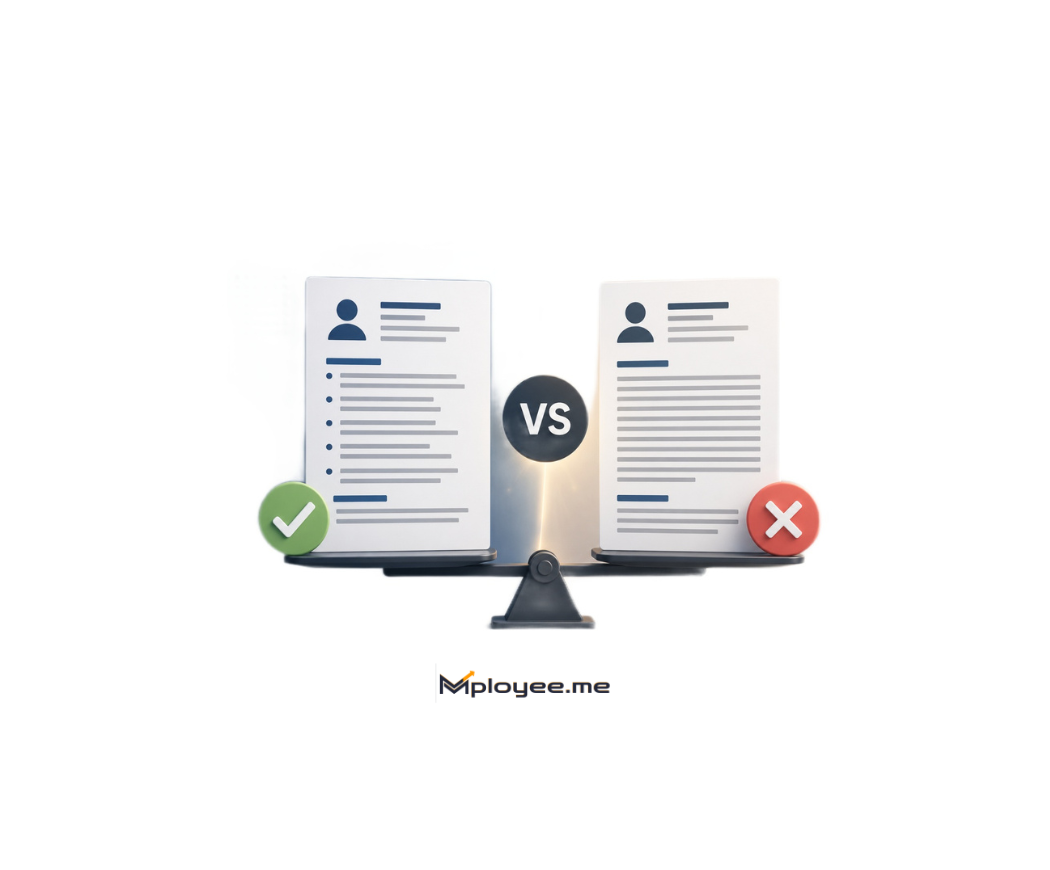
Bullet points are better than paragraphs for writing a resume in 2026. They break your experience into clear, easy-to-read statements and help recruiters quickly notice your skills, responsibilities, and achievements. Bullet points work best in sections such as work experience, internships, projects, and accomplishments.
Paragraphs are not completely unsuitable, though. A short paragraph can be useful in your professional summary or when you need to briefly explain the scope of a senior role. For most resumes, the best approach is to use a short summary paragraph at the beginning and concise bullet points throughout the experience section.
TL;DR
- Use bullet points instead of paragraphs to make your resume easier to scan.
- Apply bullets to experience, projects, and achievements; keep paragraphs only for summaries.
- Start each bullet with an action verb and focus on what you did.
- Include measurable results or impact whenever possible.
- Keep bullets short, relevant, and tailored to the job.
We'll cover:
Should I Use Paragraphs in My Resume?
No, you should not use paragraphs for most parts of your resume. Work experience, internships, projects and achievements are generally easier to understand when written as short bullet points. A brief paragraph can still be used in your professional summary. However, writing every responsibility and achievement in paragraph form can make the resume difficult to scan.
A recruiter should not have to read a complete block of text to find your strongest skills or results. Your resume should make the most important information visible immediately.
Paragraphs Are Difficult for Recruiters to Scan
Paragraphs make it harder for recruiters to quickly understand your resume. Recruiters usually spend only a few seconds, so long text slows them down. Important details can easily get missed.
- Long paragraphs require full reading to understand key points
- Important skills and results are not clearly visible
- Resume bullet points make information quick and easy to scan
Example of Experience:
Managed digital marketing campaigns across Google Ads, LinkedIn and Meta while working with the content and design teams to increase website traffic, generate leads and improve campaign performance.
Now look at the same information in bullet points:
- Managed paid campaigns across Google Ads, LinkedIn and Meta
- Worked with content and design teams to execute campaigns
- Increased website traffic by 32% in six months
- Reduced cost per qualified lead by 18%
Paragraphs Hide Measurable Achievements
Paragraphs often hide important numbers and results. Achievements like growth, savings, or improvements are not clearly visible. Recruiters may miss your strongest points.
- Key results like percentages and numbers get buried
- Achievements are not highlighted properly
- Bullet points make results stand out clearly
Example of Measurable Achievements:
Managed sales operations for multiple regions, worked with channel partners and helped increase revenue by 28% while reducing reporting time by 10 hours.
Now see the bullet point version:
- Increased regional sales revenue by 28% through better partner management
- Automated the reporting process, saving 10 hours every month
Paragraphs Make a Resume Look Crowded
Too many paragraphs can make your resume look messy and difficult to read. A crowded resume feels heavy and confusing. It reduces readability and impact.
A crowded resume usually has:
- Long text blocks reduce white space
- Too many ideas are packed together
- Important points get lost in details
Paragraphs Encourage Unnecessary Information
Paragraphs often lead to adding extra and unnecessary details. People tend to explain too much, even things that are not important. This makes the resume longer without adding value.
Your resume does not need to include:
- Every small task you did
- Every meeting you attended
- Full background of every project
- Responsibilities that are already obvious
- Personal opinions about your work
Why Should I Use Bullet Points in My Resume?
You should use bullet points in your resume because they make it easier to separate responsibilities from achievements. They also keep the information clear, easy to read, and quick to understand. Recruiters can quickly identify your skills, experience, and accomplishments without having to read long paragraphs.
Bullet points make a resume easier to read
Firstly, bullet points make your resume easier to scan because they break information into small, clear sections. Recruiters can quickly understand your experience without reading long paragraphs.
- Each point focuses on one idea
- Improves readability and structure
- Helps recruiters scan resumes in under 6–8 seconds
Bullet points help highlight achievements
Firstly, bullet points help you clearly show what you achieved instead of just listing tasks. They make your results stand out in a simple and direct way.
- Separates achievements from daily duties
- Highlights measurable results like 20% growth
- Makes your contributions easy to notice
Bullet points make resume tailoring easier
Bullet points make it much easier to adjust your resume for different job roles. Instead of rewriting long paragraphs, you can quickly update or rearrange points to better match what each employer is looking for.
- Simple to edit or move around
- Helps align your resume with job descriptions
- Saves time when applying to multiple roles
If you want to make this process even smoother, our Resume Keywords Tool can help. It scans your resume against a job description and shows how well they match. You’ll get a clear score and suggestions on what to improve, so you can tailor your resume quickly and confidently.
Bullet points help me write concisely
Firstly, bullet points help you write in a short and clear way by removing unnecessary words. They keep your resume focused and easy to understand.
- Encourages action-based writing
- Avoids long and complex sentences
- Keeps content simple and direct
Bullet points make impact more visible
Firstly, bullet points make your achievements more noticeable by highlighting results clearly. Recruiters can quickly see your value.
- Shows numbers like 25% increase or 15% cost reduction
- Highlights growth and improvements
- Makes your impact easy to understand
- Increased trial-to-paid conversion from 8% to 13%.
- Managed ₹20 lakh in monthly advertising spend.
- Resolved an average of 60 customer queries per week.
- Reduced order-processing errors by 22%.
- Delivered 14 product releases within one year.
- Led a cross-functional team of 11 employees.
Make Your Resume ATS-Friendly with Bullet Points
Using bullet points in your resume makes it easier for both hiring managers and ATS (Applicant Tracking Systems) to understand your information. When your content is clear and well-organized, it improves your chances of getting noticed.
- Keeps your resume neat and easy to follow
- Helps ATS pick up important keywords quickly
- Works smoothly with most standard resume formats
If you're not sure how your resume is doing, you can try our ResuScan tool. ResuScan is an ATS checker and it has scanned over 7 Lakh+ resumes. Out of the total resumes scanned, only 5% had an ATS score of 80% and more. This clearly shows how important it is to make your resume ATS friendly.
Mployee Me’s 2026 ATS score benchmark report analysed 734,492 aggregate ATS scans and recommends improving factors such as bullet clarity, measurable impact, formatting, keyword fit and role relevance when a resume needs stronger readiness. The report also explains that an ATS score is a readiness indicator rather than a guarantee of interviews.
Are Bullet Points Better Than Paragraphs in a Resume?
Yes, Bullet points are better than paragraphs for most resume sections. They are easier to scan, make measurable achievements more visible and help candidates tailor their experience for different positions. Paragraphs are still useful in limited situations, particularly when you need to provide brief context.
| Resume Requirement | Bullet Points | Paragraphs |
|---|---|---|
| Showing achievements | Recommended | Results may get buried |
| Describing work experience | Recommended | Usually too dense |
| Displaying measurable impact | Clear and visible | Harder to notice |
| Providing short career context | Limited | Useful |
| Professional summary | Can work | Can work when brief |
| Tailoring for each job | Easier | More difficult |
| Creating white space | Better | Can look crowded |
| ATS readability | Safe with standard bullets | Usually readable as normal text |
| Executive role overview | Use after overview | Useful for one or two lines |
Best Way to Add Bullet Points in the Resume Work Experience Section
The best way to write resume bullet points is to clearly show what you did, how you did it, and what result you achieved. Each bullet should start with an action, explain your work, and end with a result whenever possible.
A simple structure you can follow is:
Action verb + what you worked on + how you did it + result
Follow the Steps to write work Experience Section:
- Step 1: Start with a Strong Action Verb: Start each bullet point with a clear action verb so your role looks strong and active. Use words like led, managed, improved, or developed based on your work. Avoid repeating the same words again and again, as varied action verbs make your resume more engaging and professional.
- Step 2: Clearly Explain What You Did: After the action word, explain your work in a simple and clear way so recruiters understand your role easily. Avoid vague lines and give proper context.
- Step 3: Add Scope to Your Work: Always show the scale of your work by adding details like budget, team size, number of clients, or projects handled. This makes your experience look real and impactful.
- Step 4: Include a Measurable Result: Try to end your bullet points with a result to show the impact of your work. Numbers like percentage growth, cost reduction, or time saved make your resume stronger. But don’t force numbers everywhere—use them only where they make sense and add value.
- Step 5: Use Keywords Naturally: Use important keywords like SEO, Google Ads, or data analysis naturally within your sentences. This helps your resume pass ATS checks easily. Instead of listing keywords, show how you used them in real work so your skills look practical and genuine.
- Step 6: Keep Bullet Points Short and Clear: Keep each bullet point short, simple, and easy to read—ideally 1 to 2 lines. Avoid long sentences that are hard to understand.
Before:
Responsible for managing email campaigns, working with designers, reviewing reports and making improvements to increase engagement and conversions.
After:
- Managed weekly email campaigns for more than 75,000 subscribers.
- Coordinated with designers to produce 18 reusable campaign templates.
- Increased email conversion rates by 21% through segmentation and A/B testing.
- Automated performance reporting, saving five hours each week.
Which Resume Sections Should Use Bullet Points or Paragraphs?
Firstly, different resume sections need different formats to present information clearly and effectively. Using the right mix of bullet points and paragraphs helps improve readability and makes your resume easy to scan for recruiters.
| Resume Section | Recommended Format | Why |
|---|---|---|
| Professional summary | Short paragraph or 3 bullets | Provides a quick overview |
| Work experience | Bullet points | Highlights responsibilities and results |
| Internships | Bullet points | Shows practical experience |
| Projects | Bullet points | Separates contribution, tools, and results |
| Achievements | Bullet points | Makes accomplishments visible |
| Skills | Grouped list | Saves space and improves scanning |
| Education | Simple entries | Keeps qualifications clear |
| Certifications | Simple list | Easy to verify |
| Contact information | No bullets | Standard identifying details |
Key Takeaways
- Use bullet points for work experience, projects, internships, and achievements.
- Use a short paragraph only for your professional summary or brief role context.
- Keep most bullet points within one or two lines.
- Start each bullet with a clear action verb, such as “increased,” “managed,” “built,” or “reduced.”
- Focus on results rather than listing routine responsibilities.
- Add numbers, percentages, time saved, revenue, team size, or other useful measurements where they are accurate.
- Tailor your bullets to the job description by using relevant keywords naturally.
- Avoid long paragraphs, decorative bullet symbols, and unnecessary details.
- Use a simple format that is easy for both recruiters and applicant tracking systems to review.
- Three to five strong bullets under a role are usually more useful than a long list of repetitive duties.
Should Resumes Be Bullets or Paragraphs?
Resumes should mainly use bullet points for work experience, projects, internships, and achievements. A short paragraph can still work well for the professional summary or a brief introduction to a senior role.
Bullet points are generally better because they:
- Separate responsibilities from achievements
- Make skills and measurable results easier to notice
- Create more white space
- Help recruiters review information quickly
- Make it easier to tailor the resume for each job
Use a short paragraph for context and bullet points to show your experience and results.
Is 2 Bullet Points Enough for a Resume?
What Is the 3 Bullet Points Rule?
Are Bullets or Sentences Better for a Resume?
Optimizing Resume Summary for ATS: Paragraph or Bullets?
Should I Use Bullet Points or Paragraphs in a Resume for Applying to Top Tech Companies?

Got Your Answer ?

Career Blogs
Our career blog is your go-to resource for insightful advice, practical tips, and the latest trends in the job market.



Office Address: Room No 305, IIT ROPAR-TBIF, Top Floor (East Wing), M.Visvesvaraya, Rupnagar PB, 140001
- Free Online Resume Review
- Check Resume Score
- Job Description Keyword Finder
- Resume Shortlisting Software
- Resume Scanner for Jobs
- Find jobs that match with resume
- Job matching platform
- Resume job matching
- Job suggestion
- Best sites to find jobs
- Free ats resume scanner
- Auto apply for job
- Full Time Jobs
- I Need a Job
- Information Technology Jobs
Can't Find Something? Get in Touch.
©2026 Padhakku Peek A Book Pvt Ltd (Mployee.me)


