

ATS Score Benchmark Report 2026
An industry research report by Mployee.me Research, authored by Palak Jain, on ATS checker adoption, aggregate ResuScan score trends, and why an 85%+ ATS score is emerging as a competitive resume-readiness benchmark for serious job seekers in India.
download report

The candidate-side shift is now measurable.
This public page discloses aggregate and summary findings only. Underlying company datasets, source scan tables, and complete internal records are proprietary original data.
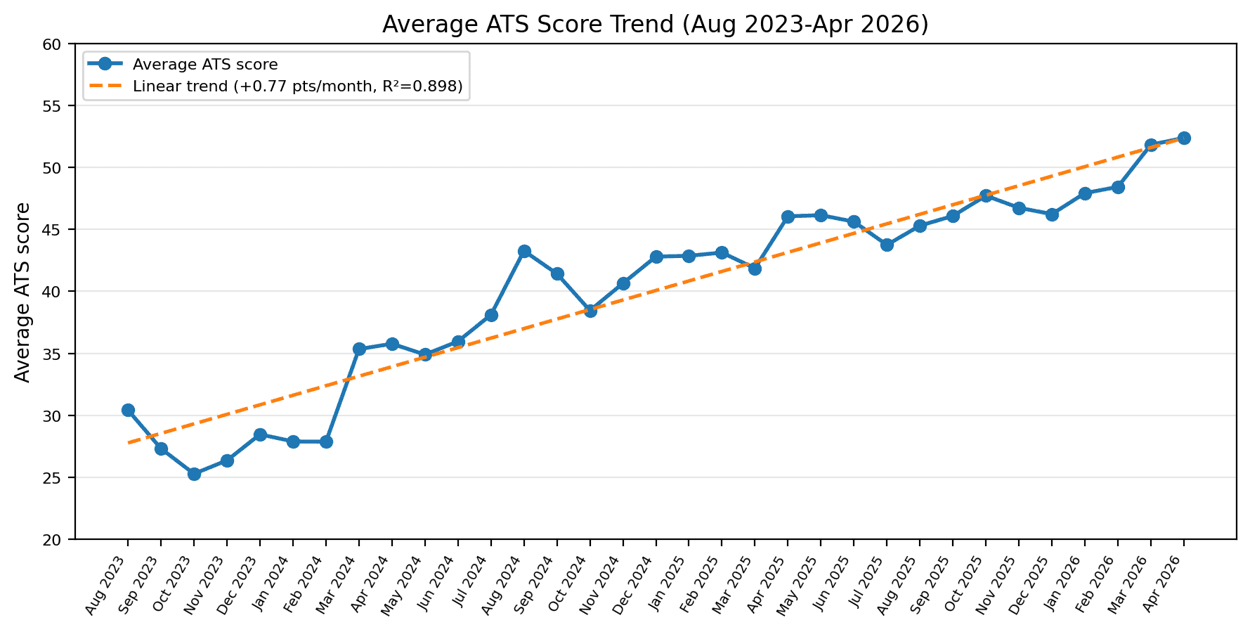
Average ATS scores have risen sharply since 2023
Across 33 score-summary records, average ATS score increased from 30.41 in August 2023 to 52.37 in April 2026. The upward trend suggests that job seekers are increasingly treating resume readiness as a measurable step before applying.
What this means
The market baseline is moving upward. A weak or average resume is less competitive than it was earlier because more candidates are now checking, improving, and tailoring resumes before applying.
Source: Mployee.me Research, ATS Score Benchmark Report 2026. Public chart based on aggregate score-summary records from August 2023 to April 2026; May 2026 excluded from summary metrics.
The 2026 job seeker must treat ATS readiness as a measurable pre-application step.
Applying with a weak or average score wastes time because the resume may fail before role fit is even evaluated.
| Candidate question | Old job-search behavior | 2026 behavior |
|---|---|---|
| Is my resume ready? | Ask a friend or use a generic template. | Measure ATS score and target 85%+. |
| Which jobs should I apply to? | Apply to many jobs randomly. | Apply to high-match roles only. |
| How do I measure progress? | Count applications submitted. | Track employer response rate and profile-role fit. |
| When should I revise? | Only after long periods without results. | After every defined application batch or when score/match is weak. |
Note: ATS readiness should be used with relevant applications, not as a replacement for role fit, experience strength, or recruiter judgment.
Turn the benchmark into a measurable job-search workflow
The report’s practical message is not to apply first and optimize later. Job seekers should scan, improve, target the readiness benchmark, apply to relevant roles, and track outcomes after every defined application batch.
Use ATS readiness before application volume.
A higher application count is not the best progress metric if the resume is weak, poorly parsed, or not aligned to the role. The stronger workflow is to improve readiness first, then apply to high-match roles.
Treat this as a competitive pre-application target, especially before applying at scale to relevant roles.
Scan the resume
Get a baseline ATS score before sending applications.
Fix real gaps
Improve structure, keywords, formatting, and evidence without adding false claims.
Target 85%+
Use the benchmark as a readiness checkpoint before applying at scale.
Apply selectively
Prioritize high-match roles instead of sending the same resume everywhere.
Track response
Review employer response rate, role fit, and missing keywords after each batch.
Note: ATS score is a readiness signal, not a guarantee of interview selection, employer response, or job offer. It works best when paired with role relevance, authentic skills evidence, and consistent application tracking.
About the report author and research publisher
This block makes the research page feel more credible for readers, publishers, journalists, and AI systems by clearly showing who authored, published, and maintains the report.
About The Author
Palak Jain is the Founder of Mployee.me and the author of the ATS Score Benchmark Report 2026. Through Mployee.me’s flagship resume analysis tool, ResuScan, she has studied job seeker resume-readiness behaviour using more than three years of internal ATS score data.
The report is based on month-over-month analysis of aggregate ResuScan data and examines how job seekers are increasingly using AI-powered resume checks, ATS score analysis, and keyword optimization before applying to jobs. Her research focuses on candidate-side AI adoption, changing resume improvement patterns, and the growing importance of measurable ATS readiness in the modern hiring process.Under her leadership, Mployee.me has helped 400,000+ job seekers improve their resumes, discover relevant job opportunities, and apply more effectively through AI-powered tools such as ResuScan and Job Match Pro.
Author of the ATS Score Benchmark Report 2026.
Published under the Mployee.me Research identity.
Use this email for report-related outreach, citation queries, and corrections.
Source scan tables, individual resume data, and complete internal records are retained privately as proprietary original data. This keeps the report useful for public citation while protecting underlying candidate and platform-level data.
Resume optimization is moving from guesswork to readiness benchmarking.
ATS Score Benchmark Report 2026 is an industry research report by Mployee.me Research focused on ATS checker adoption and resume-readiness trends among job seekers in India.
Based on aggregate ResuScan data from August 2023 to April 2026, the report shows a clear rise in average ATS scores and explains why an 85%+ ATS score is emerging as a competitive benchmark for serious job seekers.
It also includes validation from a 200-candidate observational study, where candidates with 85%+ ATS scores showed up to 3%–5% response rates when applying to relevant jobs.
The report connects candidate-side ATS optimization behavior with broader AI adoption in recruitment and highlights the importance of scanning, improving, tailoring, and applying to high-match roles.
What was measured?
The methodology separates average score movement from the recommended competitive readiness benchmark.
| Item | Public disclosure | Interpretation |
|---|---|---|
| Preprint metadata | Posted 15 May 2026, 16:37; authored by Palak Jain; DOI: 10.6084/m9.figshare.32300481 | Use the DOI for citations and backlink consistency across Figshare, guest posts, and partner references. |
| Dataset period | August 2023 to April 2026 | May 2026 is excluded from summary metrics and charts. |
| Records analyzed | 33 score-summary records | Used to measure directional ATS score movement over time. |
| Total scans | 734,492 aggregate scans | Disclosed only as an aggregate figure; source scan tables remain private. |
| Latest included score | 52.37 in April 2026 | This is the observed latest average, not the recommended competitive target. |
| Candidate validation | 200-candidate observational sample | Used to understand practical response signals across ATS-score bands. |
Two signals matter most.
The first signal is market movement: average ATS scores are rising. The second signal is performance: the strongest readiness band appears at 85%+ when candidates also apply to relevant roles.
Finding 1: Average ATS scores rose sharply.
Average ATS score increased from 30.41 in August 2023 to 52.37 in April 2026, a gain of 21.96 points.
Finding 2: 85%+ is the practical readiness target.
In the 200-candidate observational validation sample, candidates at the 85%+ readiness level showed an observed employer response rate of up to 3%–5%, especially when applications were aligned to relevant roles.
What does an ATS score mean in 2026?
85%+ is not presented as the statistical average. It is presented as the recommended competitive readiness level before applying at scale.
| ATS score band | Readiness interpretation | Recommended action |
|---|---|---|
| Below 50% | Weak readiness; likely issues with structure, parseability, or role alignment. | Fix formatting, standard sections, missing keywords, and unclear experience evidence before applying. |
| 50%–69% | Close to the emerging baseline, but not strong enough for competitive applications. | Use ATS feedback to improve keyword fit, bullet clarity, measurable impact, and role relevance. |
| 70%–84% | Good resume readiness, but still below the proposed competitive norm. | Tailor the resume to target roles and close missing keyword gaps before high-volume applications. |
| 85%+ | Competitive readiness level for serious job seekers in an AI-filtered market. | Apply to high-match jobs, track response rate, and keep optimizing based on job descriptions. |
Note: An ATS score is a readiness signal, not a hiring guarantee. Interview calls depend on role relevance, candidate profile strength, notice period, salary fit, location, hiring cycle timing, and employer-specific criteria.
The new job-search workflow: scan before applying.
Candidates should measure readiness first, improve honestly, then apply to relevant jobs.
Scan
Upload the resume and establish a baseline ATS score.
Diagnose
Find formatting, keyword, readability, and section-level issues.
Rewrite
Improve bullets, achievements, structure, and role-specific evidence.
Tailor
Create resume versions for specific job families or roles.
Rescan
Check progress and target 85%+ readiness before applying.
Apply
Apply to high-match jobs and track employer response rate.
ATS score alone is not enough. Role match matters too.
The strongest workflow combines resume readiness with job relevance: improve the resume, then prioritize jobs where the resume already has a strong match.
Layer 1: ResuScan
ResuScan is the readiness layer. It checks whether a resume is structured, readable, keyword-aligned, and strong enough for ATS and recruiter review.
- ATS score and resume-readiness feedback
- 40+ ATS and HR-based checks
- Formatting, keywords, readability, measurable impact, and section quality
- Best used before applying to important roles
Layer 2: Job Match Pro
Job Match Pro is the relevance layer. It helps candidates prioritize fresh jobs that match their resume, skills, and experience instead of applying randomly across portals.
- Resume-to-job match score for recommended roles
- Fresh job discovery across multiple platforms
- Missing keywords and skills for each target job
- Best used after the resume reaches a stronger readiness band
Why this matters now
Employer-side hiring is becoming more automated, and candidate-side preparation is becoming more measurable.
Recruiters are increasing AI use.
LinkedIn’s 2026 research reported that 93% of recruiters planned to increase their use of AI, and many also planned to increase AI use in pre-screening workflows.
Recruiting is a major HR AI use case.
SHRM’s AI-in-HR research describes AI use across recruiting tasks such as job descriptions, resume screening, candidate sourcing, and applicant communication.
Hiring AI is becoming governance-sensitive.
The EU AI Act identifies employment-related AI tools, including CV-sorting software and systems used to analyze or filter job applications, as high-risk use cases.
India’s skills market is changing quickly.
World Economic Forum analysis points to strong technology-driven labor-market transformation in India, with demand for big data, AI, machine learning, and security management skills.
What this report does not claim
Important interpretation notes
- This report uses aggregate platform data and summary metrics, not public raw scan-level data.
- Underlying company datasets and source scan tables are proprietary original data.
- The 200-candidate validation sample is observational, not a randomized controlled trial.
- 85%+ is a competitive readiness benchmark, not a guarantee of interview calls or job offers.
- Response rates vary by industry, role, location, salary expectation, notice period, and hiring cycle.
- ATS readiness works best when paired with relevant applications and authentic skill evidence.
Common questions about the 85% ATS benchmark
These answers clarify how to interpret ATS score, benchmark targets, and resume-to-job matching without overstating the hiring outcome.
What ATS score should I aim for before applying?
Target 85%+ before applying at scale. Treat it as a competitive resume-readiness benchmark, not a guarantee of interviews.
Does an 85% ATS score guarantee interview calls?
No. Interview calls also depend on role relevance, skills, experience, notice period, salary fit, location, timing, and employer-specific criteria.
Why is the observed average ATS score lower than 85%?
The latest observed average of 52.37 is a market movement signal. The 85%+ figure is the recommended competitive target for serious applicants.
How should candidates use ATS score with job matching?
Scan the resume, fix formatting and keyword gaps, tailor it to target roles, rescan, then apply to high-match jobs instead of applying randomly.
Sources used for this public report page
Keep this section visible. It improves trust, helps citation consistency, and reduces the risk of the page looking like a thin marketing asset.
Source use: The review maps LLM use across hiring stages and identifies concentration in screening, interviewing, ranking, summarization, and assessment tasks.
Source use: Supplementary dataset referenced for the employer-side LLM hiring literature map.
Source use: Reported global growth in recruiter AI use and job seeker AI adoption.
Source use: Reported India-specific LinkedIn findings on applicants per role and recruiter difficulty finding qualified talent.
Source use: Reported India-specific LinkedIn findings on job seeker AI adoption.
Source use: Provides the official European Commission overview of the AI Act, its risk-based approach, and high-risk employment examples including CV-sorting software for recruitment.
Source use: Provides Annex III text identifying recruitment, job-application filtering, and candidate evaluation AI systems as high-risk employment-related use cases.
Source use: Reports organizational use of AI in recruiting, including resume screening and candidate search.
Source use: Provides broader labor market context on skills transformation and employer workforce strategies.
Source use: Provides India-specific labor-market context and skills-based hiring transition.
Source use: Provides recruiting and quality-of-hire context.
Suggested citation
Use this citation when referencing the report from guest posts, research roundups, career blogs, media mentions, or partner websites.


