

We'll cover
How to Find and Apply to Fresh Jobs Within 24 Hours
Written by Palak Jain

We'll cover:
Why Should You Apply for the Latest Jobs?
Your application for the latest jobs enables you to reach recruiters when they are most active in reviewing resumes, comparing applicants, and shortlisting candidates. When you apply to a recently posted job, you have a better chance of getting noticed than applying to a job that has already been open for many days.
- You Get an Early Advantage: By applying to recent jobs, your resume is more likely to be seen before the recruiter’s attention starts shifting to a large number of applications. When you apply within the first 24 to 48 hours after a job is posted, recruiters are often still actively looking for suitable candidates for the role.
- Better Visibility: New job listings usually attract fewer applicants in the beginning. This means there is less chance of your application getting buried under hundreds of other resumes. When you apply early to a role that matches your skills and experience, your profile has a better chance of standing out.
- Saves Time and Effort: As of February 2026, Job Match Pro has recommended 5.5 lakh+ jobs and provides access to 8 lakh+ latest job listings from platforms like LinkedIn, Naukri, Foundit, Google Jobs, Workday, and company career pages, bringing everything into one place.
- Higher Chance of Shortlisting: When you apply early to a relevant job, your chances of getting shortlisted can improve. Recruiters usually prefer candidates whose skills and experience match the role clearly. So, instead of applying to every opening, focus on jobs that fit your profile, location, experience level, and career goals.
In short, the latest jobs give you a better chance to apply at the right time with less competition. The sooner you apply to a relevant opening, the higher your chances of getting noticed.
5 Hacks to Find Latest Jobs Using Job Portals
Finding the latest jobs is not difficult, but most people do it the wrong way. They search for a job title, scroll through hundreds of listings, and apply without checking whether the job is fresh or relevant.
A better method is to use each job portal smartly. Every platform has filters, search options, and small tricks that can help you find newly posted jobs faster.
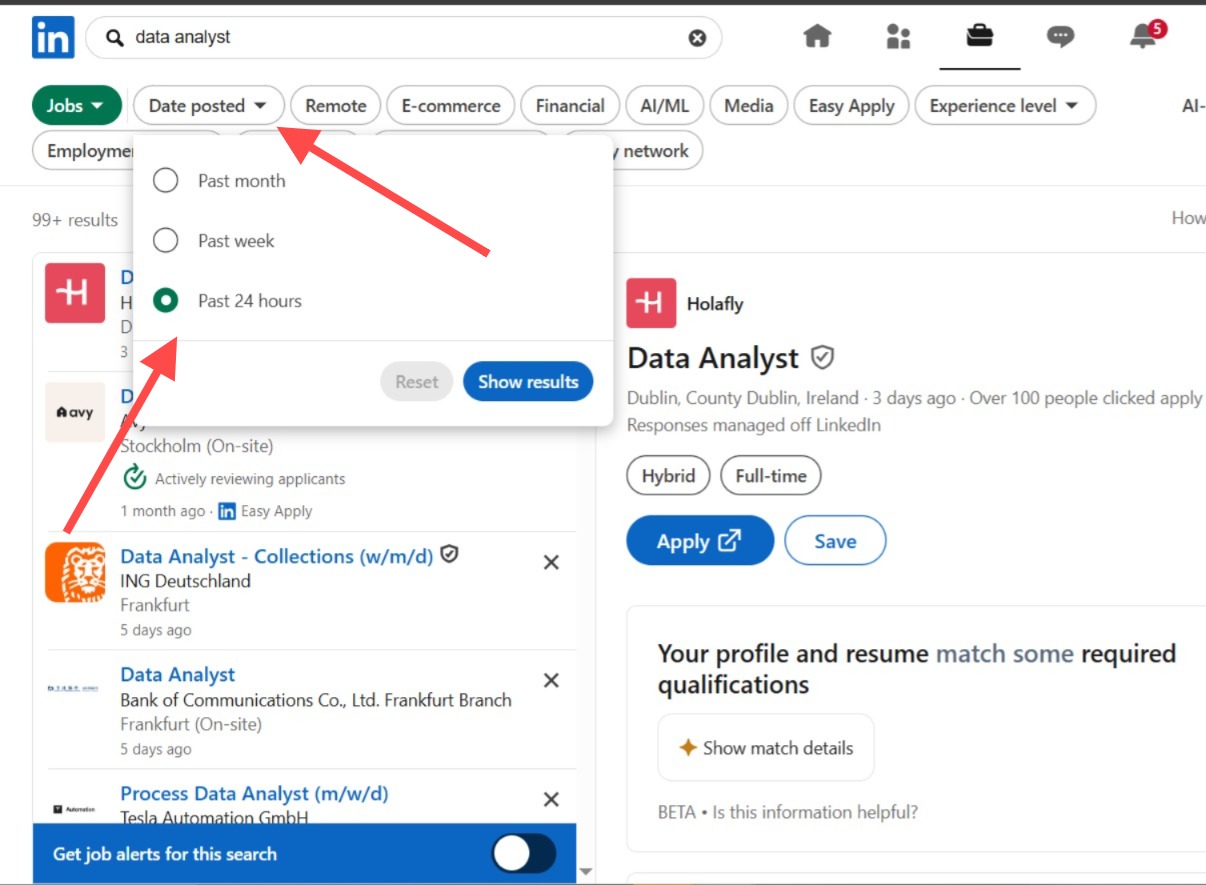
1. LinkedIn: Use the “Past 24 Hours” Filter
LinkedIn is one of the best platforms to find latest job openings, but only if you use the right filters.
- First, search for your job title, such as Digital Marketing Executive, Software Developer, or Data Analyst.
- Then, add your preferred location, like Delhi, Mumbai, Bangalore, or Remote.
- Next, open the Date Posted filter and select Past 24 hours to see the latest jobs.
- After that, use filters like experience level, job type, remote, hybrid, or on-site.
- Finally, read the job description, check the required skills, and apply with a customized resume.
- You can also use a small LinkedIn URL trick. In LinkedIn job search URLs, filters like f_TPR=r86400 usually show jobs posted in the last 24 hours, and f_TPR=r3600 can help you find jobs posted in the last hour.
This helps you avoid old listings and apply while recruiters are still actively checking applications.
This is useful when you want to apply early before the job gets too many applicants.
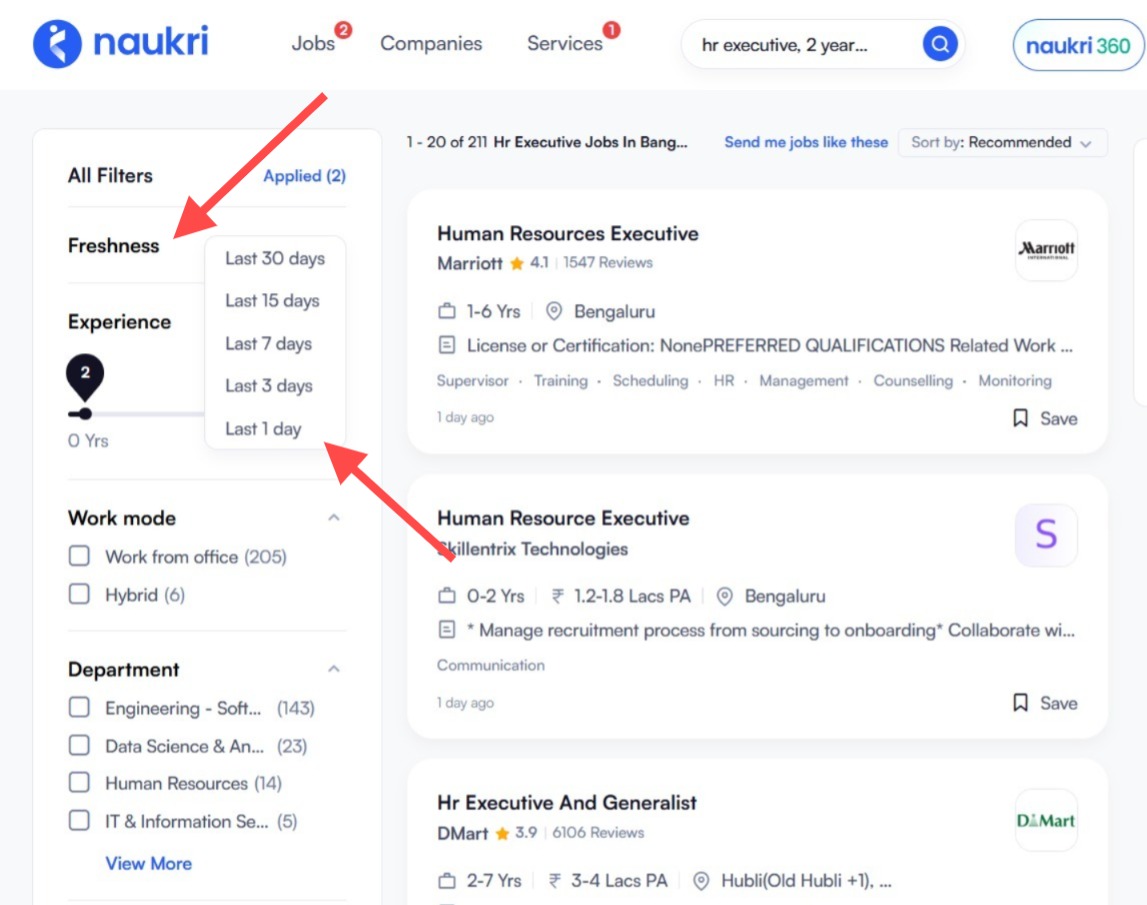
2. Naukri: Sort Jobs by Freshness
Naukri is one of the most used job portals in India, so new jobs can get many applications quickly. To find fresh openings, use filters properly instead of only searching by job title.
- First, search for your job title, such as Sales Executive, HR Recruiter, Java Developer, or Data Analyst.
- Then, add your preferred location, like Delhi, Mumbai, Bangalore, Pune, or Remote.
- Next, use the Date Posted filter and select recently posted jobs to find the latest openings.
- After that, apply filters like experience, salary, industry, company type, and work mode.
- Finally, read the job description carefully, check if your skills match the role, and apply with a customized resume.
After searching, focus on jobs posted recently. Also, keep your profile updated because recruiters often search for active candidates. Even a small update to your resume, skills, or headline can make your profile look fresh.
For better results, use specific searches like “Java Developer 2 years Bangalore” instead of only “Java Developer.”
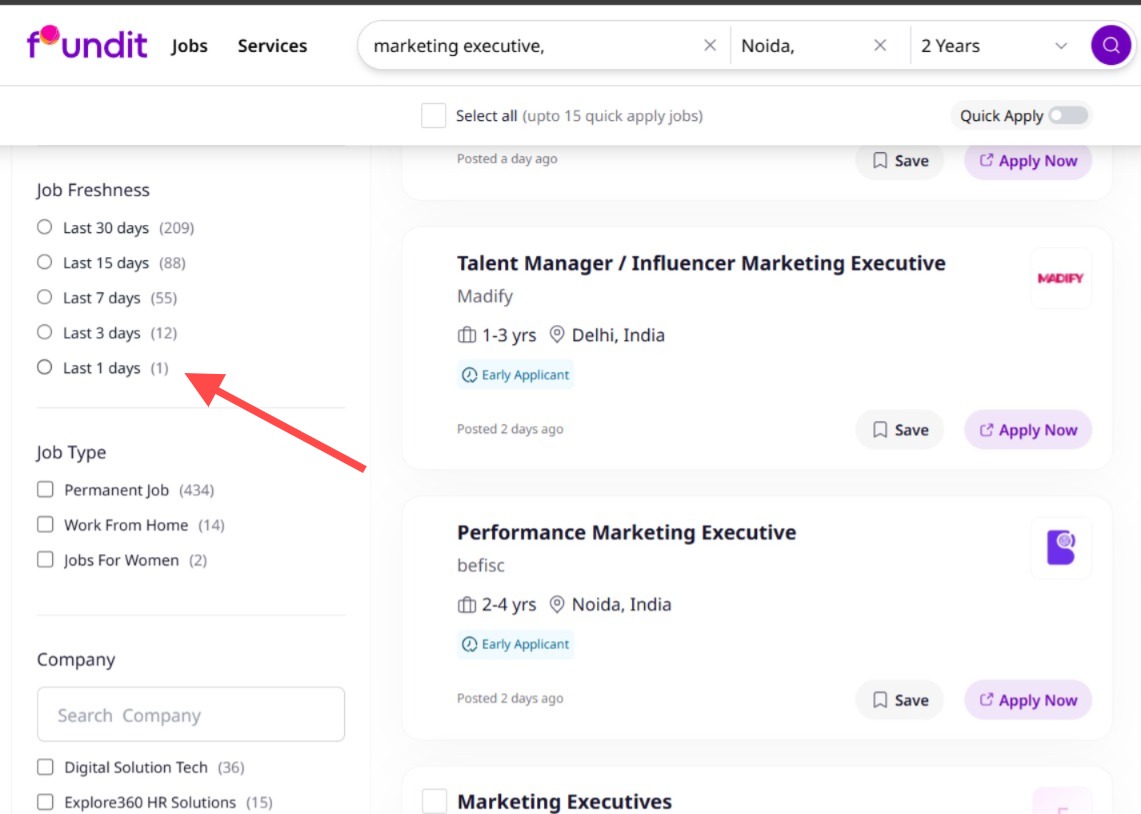
3. Foundit: Use Advanced Search Filters
Foundit can help you find relevant jobs faster when you use advanced filters properly. Search for your role and then narrow the results by experience, location, salary, industry, and job type.
- First, search for your job title, such as SEO Analyst, Performance Marketing Executive, Software Developer, or Customer Support Executive.
- Then, add your preferred location, like Mumbai, Delhi, Bangalore, Pune, or Remote.
- Next, use filters like experience, salary, industry, and job type to remove unrelated jobs.
- After that, avoid broad searches like marketing jobs because they may show too many random results.
- Instead, search for specific terms like performance marketing executive jobs in Mumbai or SEO analyst jobs remote.
Finally, read the job details properly and apply only if the role matches your skills, experience, and career goals. This saves time and helps you focus on better opportunities.
4. Google Jobs: Search with Fresh Keywords
Google Jobs can collect job listings from many websites in one place. You can search using simple phrases like:
latest data analyst jobs in Pune
software developer jobs posted today
digital marketing jobs last 24 hours
remote jobs hiring now
After searching, use filters like location, date posted, company type, and job type. Google Jobs is helpful when you want to compare openings from different platforms without opening each site separately.
5. Company Career Pages: Apply Directly
Many companies post jobs on their own career pages before they appear on job portals. This means you may find some openings earlier than other candidates.
Make a list of companies you want to work for and check their career pages regularly. You can also follow these companies on LinkedIn because many HR teams post hiring updates there.
Direct applications can sometimes work better because your resume goes straight into the company’s hiring system.
This helps you apply faster, avoid random jobs, and focus only on openings where your profile has a better chance
Best Practices to Increase Your Chances of Selection
Finding a fresh job is only the first step. The real benefit comes when you apply early, apply to the right role, and keep your job search organized. A job posted today can receive hundreds of applications within a few days, so your timing and relevance matter a lot.
Here are a few simple practices that can improve your chances of getting noticed.
1. Apply within the first 24 hours
Try to apply as soon as you find a relevant job. Many recruiters start checking applications soon after a job goes live. If you apply early, your profile has a better chance of being seen before the listing becomes crowded.
Make it a habit to check fresh jobs once or twice every day. Focus on jobs posted in the last 24 hours instead of spending time on old listings.
2. Use freshness filters on job portals
Do not search randomly. Use filters that show recently posted jobs.
On LinkedIn, use the “Past 24 hours” filter. On Naukri, sort or filter jobs by freshness. On Google Jobs, search with terms like “posted today,” “last 24 hours,” “hiring now,” or “new jobs today.”
This small habit helps you avoid expired or overcrowded job posts.
3. Search with specific role and location keywords
Broad searches like “marketing jobs” or “IT jobs” can show too many random results. Use specific searches instead.
For example:
- Data Analyst jobs in Pune posted today
- HR Recruiter jobs in Delhi last 24 hours
- Software Developer remote jobs hiring now
- Digital Marketing Executive jobs in Bangalore
- Fresher jobs posted today in Mumbai
The more specific your search is, the better your results will be.
4. Check company career pages directly
Do not depend only on job portals. Many companies post openings on their own career pages before the same roles appear on other websites.
Create a small list of companies you want to work for and check their career pages regularly. This is especially useful if you are targeting specific companies, startups, MNCs, or remote-first teams.
5. Turn on job alerts
Job alerts save time because you do not need to search every platform manually again and again. Set alerts on LinkedIn, Naukri, Google Jobs, Foundit, and company career pages wherever possible.
Keep your alerts specific. Add the exact role, location, work mode, and experience level. For example, “Remote Content Writer jobs,” “Fresher Software Developer jobs in Bangalore,” or “Sales Executive jobs in Delhi NCR.”
Good job alerts help you find fresh job vacancies faster.
6. Use Job Match Pro to save time
Checking LinkedIn, Naukri, Foundit, Google Jobs, Workday, and company career pages separately can take a lot of time. Job Match Pro makes this easier by showing relevant latest jobs from major platforms in one place.
It analyzes your resume, skills, experience, and preferences, then suggests jobs that match your profile. Each job also comes with a match score, so you can quickly understand how relevant the role is for you.
This helps you avoid random applications and focus on jobs where your profile is a better fit.
8. Apply to relevant jobs, not every job
Applying to more jobs is not always better. Applying to the right jobs is better.
Before applying, check whether the role matches your skills, experience, location, salary expectations, and career goal. If the job does not match your profile at all, skip it and focus on better opportunities.
A focused job search will always work better than random applications.
Common Mistakes to Avoid While Applying for Jobs
Before we go into the mistakes, here is something important based on real data.
We analyzed 10,000 applications submitted through Job Match Pro, and the results were very clear:
- Applications submitted within the first 24 hours received 2.8x more recruiter views
- Applications with an ATS score above 80 got 34% more responses
- LinkedIn generated around 42% of total interview calls
This shows that timing, relevance, and platform choice really matter. Now let’s look at the common mistakes people make and how you can avoid them.
1. Applying to old job posts
Old listings often already have too many applicants, or the role may not even be active anymore. Focus on jobs posted in the last 24–48 hours and avoid listings that are more than a few days old unless they are niche roles.
2. Searching without filters
Many job seekers skip filters and end up scrolling through outdated jobs. Always use “Past 24 hours” or “Recently posted” filters because this helps you find fresh opportunities faster.
3. Applying to random jobs
Applying everywhere without thinking does not help. Choose roles that match your skills and experience because quality applications work better than quantity.
4. Ignoring company career pages
Some of the best opportunities are not posted on job portals immediately. Visit company career pages regularly, Especially for companies you really want to work with.
5. Not setting job alerts
If you only search manually, you may miss new jobs. Set alerts on LinkedIn, Naukri, and Google Jobs, also Use specific keywords for better results.
Avoiding these mistakes can make your job search more focused and effective. Small changes in your approach can lead to better results over time.
Key Takeaways
- Use “Past 24 hours” and “Recently posted” filters to find fresh jobs.
- Search specific role + location combinations instead of broad job terms.
- Set job alerts for your target roles and locations.
- Check company career pages directly.
- Track every job application.
- Use Job Match Pro for AI job matching and jobs as per resume.
- Keep ATS and resume optimization advice in a separate dedicated guide.
What is the best way to apply for jobs online?
The best way to apply for online jobs is to first create a professional resume with each successfully tailor-made for the job being applied for and then have these resumes uploaded onto well-known and reputable job portals. Setting up job alerts ensures you never miss out on the latest online jobs or new online jobs. Such tools include ResuScan to ensure an ATS-friendly resume and Job Match Pro, which recommends jobs better suited for one's skills. Post applications should be followed by professional follow-ups for better chances.
Which is the best site to apply for jobs in India?
What's the easiest job to get online?
Which job is easiest to get in India?
What is the best place to apply for jobs online?
Which is the best online job in India?

Got Your Answer ?
Learn this in 30 Seconds 👇

Career Blogs
Our career blog is your go-to resource for insightful advice, practical tips, and the latest trends in the job market.






Office Address: Room No 305, IIT ROPAR-TBIF, Top Floor (East Wing), M.Visvesvaraya, Rupnagar PB, 140001
- Free Online Resume Review
- Check Resume Score
- Job Description Keyword Finder
- Resume Shortlisting Software
- Resume Scanner for Jobs
- Find jobs that match with resume
- Job matching platform
- Resume job matching
- Job suggestion
- Best sites to find jobs
- Free ats resume scanner
- Auto apply for job
- Full Time Jobs
- I Need a Job
- Information Technology Jobs
Can't Find Something? Get in Touch.
©2026 Padhakku Peek A Book Pvt Ltd (Mployee.me)


