

We'll cover
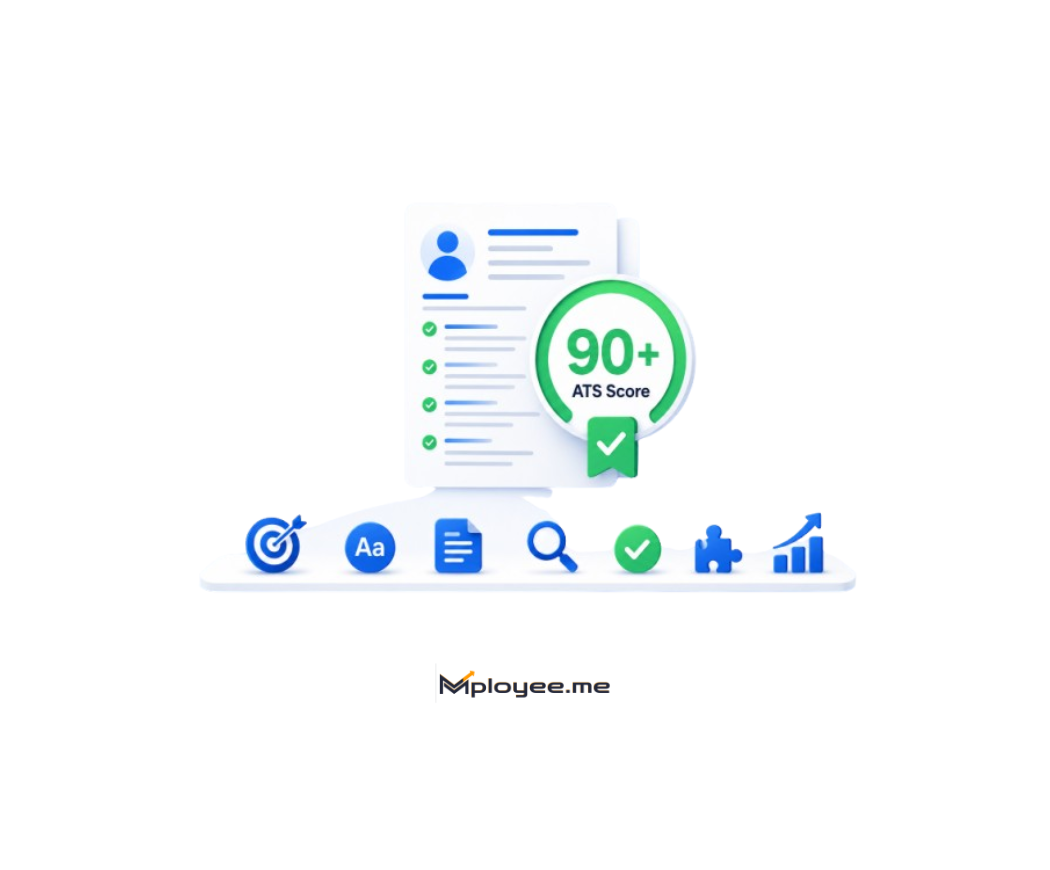
7 Things Every 90+ ATS Score Resume Has in Common: From Real ResuScan Data
Written by Jatin Batra
TL;DR
- High-scoring resumes focus on one target role instead of trying to match several unrelated positions.
- Relevant keywords are supported by real experience, projects, and measurable achievements.
- Simple formatting, standard headings, and selectable text make resume information easier to parse.
- A 90+ ResuScan score shows strong resume readiness, but it does not guarantee an interview or shortlisting.
We'll cover:
7 Things Every 90+ ATS Score Resume Has in Common: From Real ResuScan Data
Like many job seekers, I once believed that improving an ATS score was mainly about adding more keywords or choosing the right resume template.But after understanding how ResuScan evaluates resumes, I realised that high-scoring resumes are not always the longest or most visually attractive. They are focused, easy to read and clearly show why the candidate is suitable for a particular role.
The broader data also shows that resume optimisation is becoming more important. According to Mployee.me’s ATS Score Benchmark Report 2026, the average ATS score increased from 30.41 in August 2023 to 52.37 in April 2026. The report recommends treating an 85%+ ATS score as a competitive resume-readiness benchmark, not as a guarantee of interviews.
This changed the way I looked at my own resume. Instead of chasing a higher score, I started focusing on the qualities that repeatedly appear in strong, ATS-friendly resumes.
Here are seven things I learned from reviewing high-scoring ResuScan reports.
1. I Made My Target Job Role Clear
The first thing I learned was that my resume should not leave the recruiter guessing about the role I want. My professional summary, key skills and recent experience should all support the same career direction. Trying to target several unrelated roles with one resume can make the profile look unclear.
What I Changed
- I mentioned my target job title in the professional summary.
- I added my years of relevant experience.
- I highlighted two to four skills connected with the role.
- I gave more space to relevant experience.
- I removed generic statements that could apply to anyone.
- I checked whether my role-specific keywords appeared naturally.
Before reviewing my resume ATS score, I asked myself:
Which exact position should a recruiter consider me for after reading the first few lines?
When I could not answer that question clearly, I knew the resume needed more focus. A tailored and ATS-friendly resume should reflect the skills, experience and terminology required for the specific vacancy.
Generic summary: Hardworking and motivated professional looking for a challenging position in a growing organisation.
Focused summary: Data Analyst with three years of experience in SQL, Power BI, Advanced Excel and reporting automation.
2. I Stopped Listing Keywords Without Evidence
Earlier, I thought that adding skills to the Skills section was enough. I later realised that a strong resume also shows where and how those skills were used. Important resume keywords should appear naturally in Work Experience, Projects or Certifications—not only in a long skills list.
What I Started Doing
- I identified relevant skills and tools from the job description.
- I added only the keywords that genuinely matched my experience.
- I supported important skills with a work example or project.
- I used industry terminology where it accurately described my work.
- I avoided repeating terms only to improve my resume ATS score.
- I kept only the skills I could confidently explain in an interview.
Keyword listed without evidence: Skills: SQL, Power BI, Excel and data analysis
Keyword supported by experience: Built Power BI dashboards using SQL-based sales data, reducing weekly reporting time from six hours to two.
3. I Rewrote Duties as Contributions
One major weakness in my resume was that many bullets only described what I was responsible for. Recruiters already understand the usual duties connected with a role. A stronger experience bullet explains what I did, how I did it and what changed because of my work.
The Structure I Followed
Action + Work completed + Tool or skill + Result
While rewriting my experience, I:
- Started with action verbs such as managed, created, improved or automated.
- Explained the specific work I completed.
- Added relevant tools and skills naturally.
- Mention the scale, outcome or impact.
- Keep each bullet focused on one contribution.
- Removed phrases such as “responsible for” and “worked on.”
Action verbs help present accomplishments more clearly, while measurable details show recruiters the scale and outcome of your work.
Weak bullet: Responsible for preparing monthly reports.
Improved bullet: Prepared monthly Excel reports for five business units and reduced reconciliation errors by introducing a standard review process.
4. I Reduced the Number of Unrelated Skills
I once believed that a longer Skills section would make my resume look stronger. In reality, too many unrelated skills can hide the abilities that matter most for the target role. A focused Skills section helps recruiters quickly understand what I can do and where my strengths lie.
What I Changed
- I prioritised skills connected with the job description.
- I grouped similar skills into clear categories.
- I used specific tools instead of broad terms.
- I removed outdated or unrelated skills.
- I kept only skills I could explain confidently.
- I supported important skills through experience or projects.
Leadership, Java, Python, sales, SQL, Photoshop, SEO, teamwork and customer service
Data analysis: SQL, Python and Advanced Excel
Visualisation: Power BI and Tableau
Reporting: Dashboard development and reporting automation
5. I Checked Whether My Resume Could Be Parsed Correctly
My resume could look good on my screen and still be difficult for recruitment software to process. Applicant tracking systems may extract details such as skills, education, job titles, employers and employment dates into a structured candidate profile.
That made me check whether my important information remained clear after the document was parsed.
Problems I Learned to Avoid
- Two-column content appearing in the wrong order
- Employment dates becoming separated from job titles
- Contact details placed inside images
- Skills displayed only through progress bars
- Important information placed in headers or footers
- Excessive use of tables and text boxes
- Scanned or image-based PDF files
The Simple Test I Used
Before submitting my resume, I:
- Checked whether all text was selectable.
- Copied the content into a plain-text file.
- Reviewed whether the sections remained in order.
- Confirmed that job titles stayed with the correct companies and dates.
- Kept my phone number and email in the main body.
- Followed the employer’s requested file format.
My advice is to use a simple, readable ATS resume format whenever possible. A clean layout does not guarantee shortlisting, but it can reduce avoidable parsing problems and make the resume easier for both the ATS and the recruiter to understand.
6. Use Clear Headings and Keep the Formatting Consistent
I realised that a recruiter should not have to search for my experience, skills or education. Creative headings may look different, but standard headings make the resume easier to follow.
Headings I Avoided
- My Professional Journey
- What I Bring
- My Learning Path
Headings I Used Instead
- Professional Summary
- Work Experience
- Skills
- Education
- Projects
- Certifications
I also kept the same font, date format, bullet style, spacing and heading sizes throughout the document. My achievements should make the resume stand out—not mixed fonts, unusual headings or inconsistent formatting.
7. I Wrote for Both the ATS and the Recruiter
My resume may be processed by software first, but a recruiter still needs to read and understand it. That is why I stopped repeating the same keyword simply to increase its frequency.
Do not write: Project management professional with project management experience managing project management tasks.
Write: Project Manager with five years of experience leading cross-functional technology projects, managing delivery risks and improving milestone completion.
What a 90+ ATS Score Does—and Does Not—Mean
A 90+ ResuScan score means your resume has performed strongly across the checks included in the assessment. It generally suggests that the document is well structured, relevant and easy for an ATS resume checker to process.
The score may consider:
- Resume structure and formatting
- Relevant keywords
- Standard section headings
- Skills presentation
- Experience bullet quality
- Measurable achievements
- Readability
- Resume parsing
However, a high resume ATS score does not guarantee shortlisting or an interview.
It does not mean that:
- Every ATS will give your resume the same score.
- You meet every requirement in the job description.
- Every recruiter will shortlist your application.
- Keywords can replace relevant experience.
- You will automatically receive an interview.
Based on ResuScan’s framework, job seekers should generally aim for a score of 80 or above. Treat the score as a guide, not a guarantee.
Key Takeaways
- Make your target role clear by aligning your professional summary, skills and recent experience with one position.
- Use job-specific keywords only when they accurately reflect your work, projects, qualifications or certifications.
- Rewrite routine responsibilities as contributions by showing the action taken, skill used and result achieved.
- Keep the Skills section focused on relevant abilities instead of adding a long list of unrelated terms.
- Use a simple ATS resume format so contact details, job titles, dates, skills and education remain easy to extract.
- Choose standard headings such as Work Experience, Skills, Education, Projects and Certifications.
- Write naturally for recruiters while keeping the structure clear enough for applicant tracking systems to process.
- Treat your ATS score as a resume-readiness signal, not a promise of selection.
How Much ATS Score Is Safe?
An ATS score of 80 or above is generally considered a strong target within ResuScan’s framework. However, there is no universal “safe” score used by every employer or applicant tracking system.
- A higher score usually indicates better formatting, keyword alignment and resume readability.
- You must still meet the role’s experience, skills, education and eligibility requirements.
- Mployee Me’s ATS benchmark report presents 85%+ as a competitive resume-readiness target, not a guarantee of selection.
Treat your ATS score as a readiness check and use it alongside your overall match with the job.
Is a 77% ATS Resume Score Good?
Is a 75 ATS Score Good for Freshers?
Is a Two-Page Resume Okay for ATS?
How Can I Increase My ATS Score?
How Much ATS Score Is Required to Get Shortlisted?

Got Your Answer ?

Career Blogs
Our career blog is your go-to resource for insightful advice, practical tips, and the latest trends in the job market.






Office Address: Room No 305, IIT ROPAR-TBIF, Top Floor (East Wing), M.Visvesvaraya, Rupnagar PB, 140001
- Free Online Resume Review
- Check Resume Score
- Job Description Keyword Finder
- Resume Shortlisting Software
- Resume Scanner for Jobs
- Find jobs that match with resume
- Job matching platform
- Resume job matching
- Job suggestion
- Best sites to find jobs
- Free ats resume scanner
- Auto apply for job
- Full Time Jobs
- I Need a Job
- Information Technology Jobs
Can't Find Something? Get in Touch.
©2026 Padhakku Peek A Book Pvt Ltd (Mployee.me)


