

We'll cover
I Used a Job Matching Tool for 7 Days — Here’s What Happened
Written by Palak Jain
- A random job search often leads to late applications, low replies, and confusion.
- Applying to recently posted jobs within 24–48 hours can improve visibility.
- Job Match Pro helps match jobs with your resume, skills, and experience.
- Resume match scores and missing keywords can show why some applications perform better.
- A focused job search strategy is better than applying blindly to hundreds of jobs.
- Beginners should apply early, customize resumes, and target relevant job openings.
We'll cover:
Before Using Any Job Matching Tool
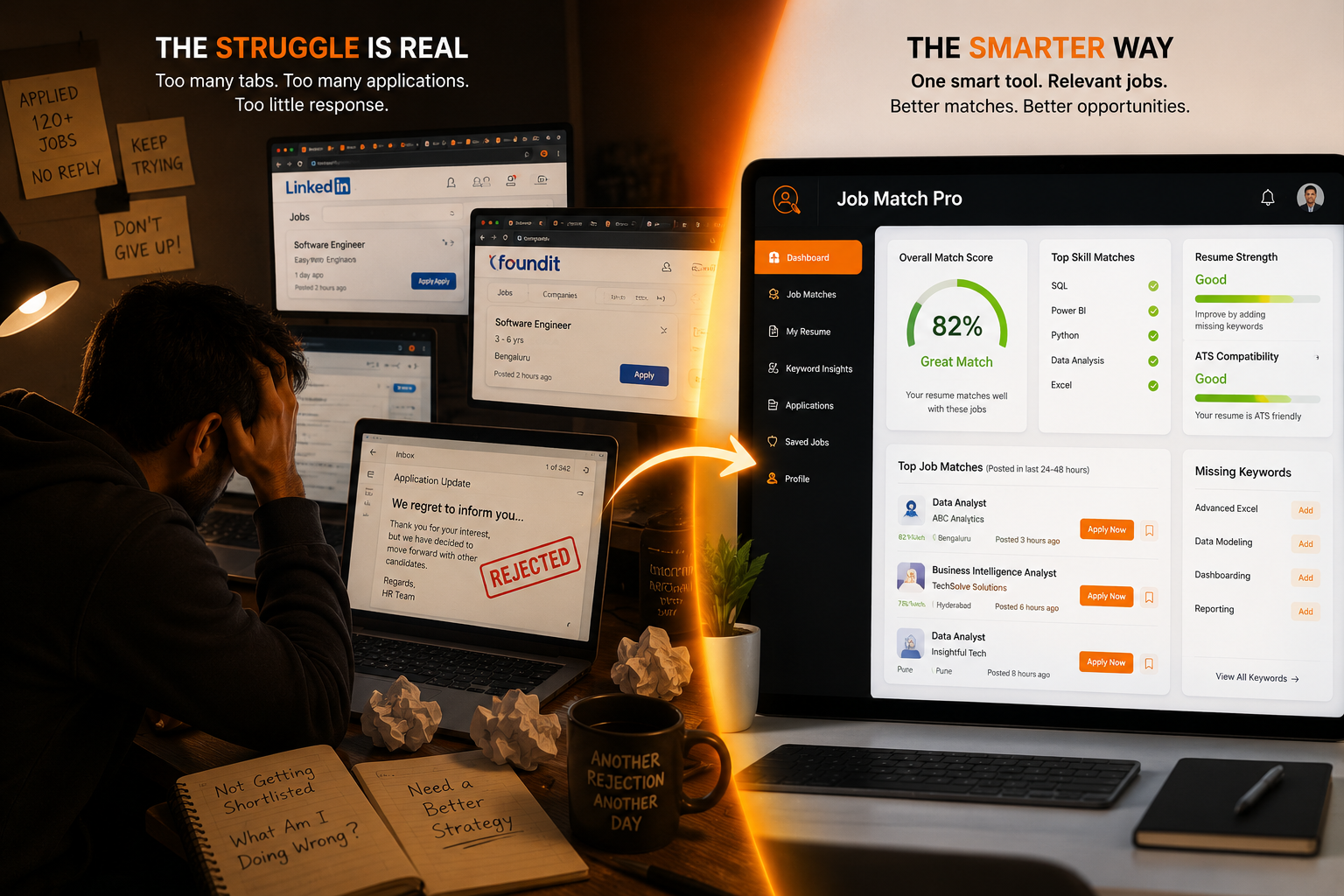
My routine before discovering job matching tools was honestly chaotic. I used to open multiple job portals separately and manually search for roles related to my skills. Sometimes I searched “Data Analyst Fresher,” sometimes “Business Analyst Entry Level,” and sometimes random combinations just hoping something useful would appear.
But there were three major problems I did not notice initially.
Problem 1: I Was Applying Too Late
This was probably the biggest mistake. I used to find jobs on one platform very late because I was switching between multiple websites throughout the day.
Morning - LinkedIn, Afternoon - Naukri, Evening - Foundit, Night - Company career pages
By the time I reached the last platform, many jobs already had hundreds of applicants. I later realized early applications matter a lot. Recruiters often shortlist the first relevant resumes quickly, especially for fresher and entry-level jobs.
Problem 2: I Applied Without Checking Resume Match
I was using the same resume everywhere. Same summary, Same skills, Same keywords. I never checked whether my resume actually matched the job description. Sometimes companies wanted SQL and Power BI, Sometimes Python and Tableau, Sometimes Excel and reporting skills.
But my resume stayed exactly the same. I genuinely believed recruiters would “understand” my profile. Now I know ATS systems do not work that way.
Problem 3: I Was Spending More Time Searching Than Applying
This was mentally exhausting. I spent hours finding jobs instead of improving my applications. Some days I would search for 4 hours and apply to only 5 jobs. At night it felt like I worked all day, but technically nothing meaningful happened. That constant cycle slowly destroys confidence. Especially when you are a beginner.
Day 1 — Discovering Job Match Pro
I found Job Match Pro while scrolling through a discussion about ATS resumes and job searching. At first, I thought it was just another job portal. But when I opened it, the concept looked slightly different. Instead of manually browsing random jobs, it was trying to match jobs according to my resume. That sounded interesting, but honestly, I did not fully understand how to use it properly. I uploaded my resume. Then suddenly I started seeing - Match scores, Missing keywords, Relevant job suggestions, Jobs posted recently, Skill-based recommendations
At first, it felt overwhelming.
I remember thinking: “What exactly am I supposed to do with all this?”, Still, I decided to test it properly for one week.
This Was Exactly How My Job Search Looked Every Day
Day 2 — Realizing Why Timing Matters
On the second day, I noticed something important. Many recommended jobs were extremely recent. Some were posted only a few hours earlier. That changed everything for me.
Earlier, I used to apply randomly whenever I found openings. But now I was seeing jobs within the first 24–48 hours of posting. And surprisingly, the applicant count was much lower. That was the first moment I realized something beginners usually ignore: Finding jobs early is almost as important as having a good resume. Because once applications cross hundreds or thousands, freshers struggle to stand out. For the first time, I felt like I was not already late.
Day 3 — Finally Understanding the Process
This was the day everything clicked.
Until Day 2, I was still using the tool casually.
But on Day 3, I finally understood how Job Match Pro was supposed to be used.
The process was actually simple:
Step 1: Upload resume
Step 2: Let the system analyze skills and experience
Step 3: Apply mainly to jobs with stronger match scores
Step 4: Check missing keywords
Step 5: Improve resume before applying
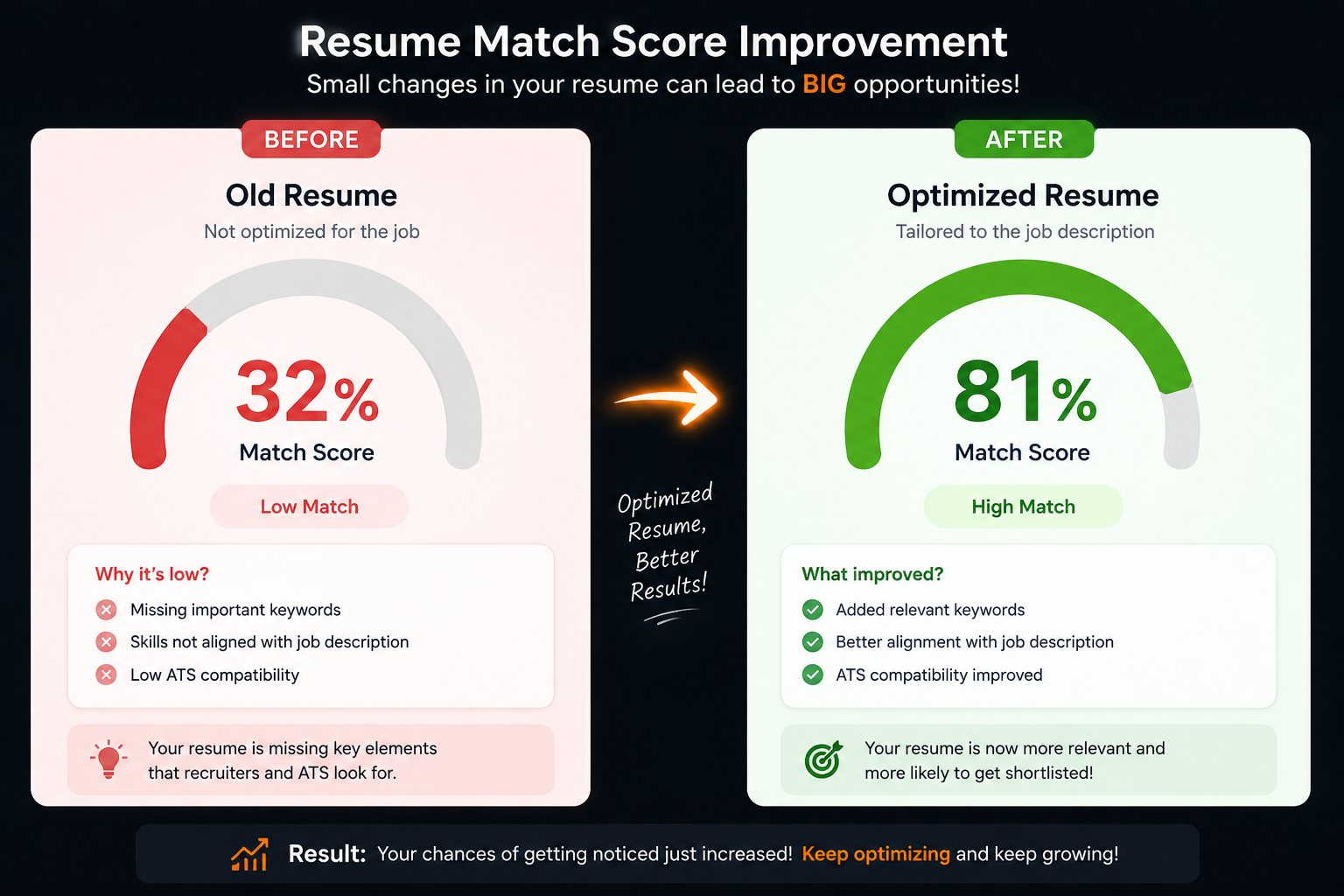
That missing keyword feature genuinely surprised me. I compared my resume against a few job descriptions and realized something embarrassing. I actually had many relevant skills. I just never mentioned them properly.
For example: I wrote “data reporting”, The job description mentioned “dashboard reporting”, I wrote: “Excel analysis”, The company wanted “advanced Excel”, I wrote: “visualization”, The recruiter searched for “Power BI”
Tiny wording differences were affecting my applications. As a beginner, nobody teaches you these things. You assume skills alone are enough. But ATS systems search for relevance and alignment. That day I edited my resume for the first time based on actual job descriptions instead of guessing.
Day 4 — My Applications Became More Focused
Earlier, I applied to everything. Literally everything. If the title looked even remotely related, I clicked Apply. But after understanding match scores, my behavior changed completely. Instead of applying to 50 random jobs, I started focusing on: Relevant roles, Recent openings, Better skill alignment, Higher match percentages. That improved my confidence immediately. Because now I actually understood why I was applying to a particular job.
Not just blindly hoping.
I also noticed something mentally important. My job search stress is reduced. Because I no longer needed to continuously switch between platforms for hours. Everything started feeling structured.
Day 5 — First Positive Signals
This was the first day I felt genuine motivation again. Not because I suddenly got hired. But because I started seeing progress. I received: More profile views, A recruiter message, One assessment link, Two application status updates; Earlier, weeks used to pass without any movement. Now within a few days, things finally felt active. I also started understanding another mistake I was making before. I used to apply mostly at night. But recent jobs perform better when applied to earlier in the day. Once I changed that habit and started applying faster to newly posted jobs, responses slowly improved. This may sound small, but for beginners, even one recruiter response can completely change confidence levels.
Day 6 — Understanding That Resume Quality Matters More Than Quantity
Before this experiment, I believed success depended on application count.
Apply more. Eventually something works. But by Day 6, I realized quality matters far more. Because if your resume is poorly aligned, applying to 500 jobs changes nothing. I started spending more time: Improving keywords, Tailoring summaries, Matching technical skills, Checking ATS compatibility, Improving bullet points, Instead of mass applying blindly. And honestly, that mindset shift alone was valuable. I stopped treating job searching like gambling. It became a process.
The Moment I Realized My Resume Was Holding Me Back
Day 7 — What Actually Changed
At the end of 7 days, I sat down and honestly compared my old approach versus the new one. The difference was huge.
Earlier I Was: Searching manually for hours, Missing recent jobs, Applying late, Using one generic resume, Ignoring ATS relevance, Feeling confused daily
After 7 Days I Was: Finding jobs faster, Applying earlier, Understanding match scores, Improving keywords, Targeting relevant roles, Tracking applications more clearly
But the biggest difference was not technical.
It was psychological. I finally stopped feeling lost. That matters a lot for beginners. Because job searching becomes emotionally exhausting when you do not understand why nothing is working.
What Beginners Usually Do Wrong
Looking back now, I think most beginners make the same mistakes I made.
Not because they are lazy.
But because nobody explains the process clearly.
Mistake 1: Applying Too Late - Jobs posted within 24–48 hours usually have lower competition compared to older listings. Timing matters more than many people realize.
Mistake 2: Using One Resume Everywhere - Different jobs search for different keywords. A resume should adapt slightly depending on the role.
Mistake 3: Focusing Only on Quantity - Sending hundreds of applications without alignment creates frustration. Relevant applications matter more.
Mistake 4: Ignoring ATS Systems - Most companies now use ATS filtering before recruiters manually review resumes. If your resume lacks proper keywords or formatting, visibility drops.
Mistake 5: Spending Too Much Time Searching - Job searching itself can consume entire days. A structured process saves both energy and focus.
The Biggest Thing I Learned
This entire experience taught me something important. Most beginners are not failing because they lack talent. They fail because they do not understand how modern hiring works. Today, job searching is not only about: Degrees, Certifications, Skills
It is also about: Timing, ATS optimization, Resume relevance, Application strategy, Early visibility
And honestly, I wish someone had explained this earlier. Because for months I thought constant rejection meant I was not capable enough. But in reality, I was simply approaching the process incorrectly.
Would I Recommend Using a Job Matching Tool?
Yes.
Not because a tool magically gets you hired. But because it gives structure to an otherwise confusing process. A good job matching platform helps you: Find recent openings faster, Avoid irrelevant applications, Understand resume gaps, Improve ATS score, Focus on better opportunities. For me, the biggest advantage was clarity.
Instead of randomly applying everywhere, I finally understood: which jobs suited my profile, why certain resumes performed better, how keywords affect ATS visibility, why recent applications matter. And once you understand the process, job searching becomes less frustrating.
Final Thoughts
If you are currently applying daily and hearing nothing back, do not immediately assume you are unqualified. Sometimes the issue is not your skills, Sometimes: your resume lacks alignment, your applications are too late, your keywords are weak, your process is unstructured, I learned this the hard way.
And honestly, those 7 days changed how I approach job searching completely. I still remember how exhausted I used to feel opening multiple tabs every morning, manually searching through endless listings, hoping something would finally work. Now the process feels smarter.
More focused, More intentional. And for the first time in a long time, job searching stopped feeling completely hopeless.
What are the 5 phases of the job search journey?
The job search journey is not only about applying to jobs. It is a complete process that starts from understanding your career goals and ends with joining a company. Most successful job seekers follow a structured approach instead of randomly applying everywhere.
The 5 phases are:
- Self-assessment and career planning
- Resume and LinkedIn optimization
- Job searching and applications
- Interview preparation and follow-ups
- Offer evaluation and onboarding
Following these phases helps job seekers stay organized, improve application quality, and increase their chances of getting shortlisted.
What are the 6 steps of job analysis?
Which is the best job matching tool for job seekers?
How can I apply to jobs faster?
What is the purpose of job matching?
How to check if a job is real or fake?

Got Your Answer ?

Career Blogs
Our career blog is your go-to resource for insightful advice, practical tips, and the latest trends in the job market.





Office Address: Room No 305, IIT ROPAR-TBIF, Top Floor (East Wing), M.Visvesvaraya, Rupnagar PB, 140001
- Free Online Resume Review
- Check Resume Score
- Job Description Keyword Finder
- Resume Shortlisting Software
- Resume Scanner for Jobs
- Find jobs that match with resume
- Job matching platform
- Resume job matching
- Job suggestion
- Best sites to find jobs
- Free ats resume scanner
- Auto apply for job
- Full Time Jobs
- I Need a Job
- Information Technology Jobs
Can't Find Something? Get in Touch.
©2026 Padhakku Peek A Book Pvt Ltd (Mployee.me)


