

We'll cover
How to Write a Resume Introduction That Hooks Recruiters?
Written by Palak Jain
- Recruiters scan resumes in seconds, so hook them instantly with resume introduction.
- Craft role-specific introductions with keywords and achievements.
- Choose summary, objective, or transition formats wisely.
- Avoid generics, long text, and duty-focused statements.
- Customize for ATS and each job to boost shortlisting.
We'll cover:
What is a Resume Introduction?
The resume introduction is the very first section that informs the recruiters and the resume shortlisting software about your identity and your significance. It establishes the expectations prior to the review of any experience.
- Definition: A resume introduction is a brief paragraph that covers your job, abilities and importance, for example, “4+ years of campaign experience in digital marketing.”
- Placement: It is located at the top of the resume so that recruiters can see it first when browsing through it.
- Purpose: It hooks the recruiter's attention by showcasing the value instantly.
- Content scope: It emphasizes the attractive points rather than the day-to-day duties.
- Professional framing: It presents you as a remedy instead of a job seeker.
- Clarity advantage: It clears any confusion about your identity and position.
A powerful opening increases the readability of the resume. It gets the recruiters ready to read more.
Why a Resume Introduction Is Critical to Hook Recruiters?
Recruiters and free online resume review tools have to go through resumes rather quickly since there are many applications. The first part usually plays a major role in deciding the shortlist.
- First-scan impact: Recruiters generally make a decision in a matter of seconds whether the resume is worth their reading.
- Attention control: A well-defined opening can very quickly hook the interest of the recruiters.
- Role confirmation: It validates whether the resume is in line with the requirements of the open position.
- Time efficiency: The recruiters depend on the introductions to speed up the screening of the resumes.
- Professional signal: An opening that is focused shows clarity and good communication skills.
- Engagement trigger: A strong introduction stimulates the reviewer to delve deeper into the candidate's experience.
Recruiter attention is confined to a narrow time window. A good introduction extracts the maximum value from those seconds.
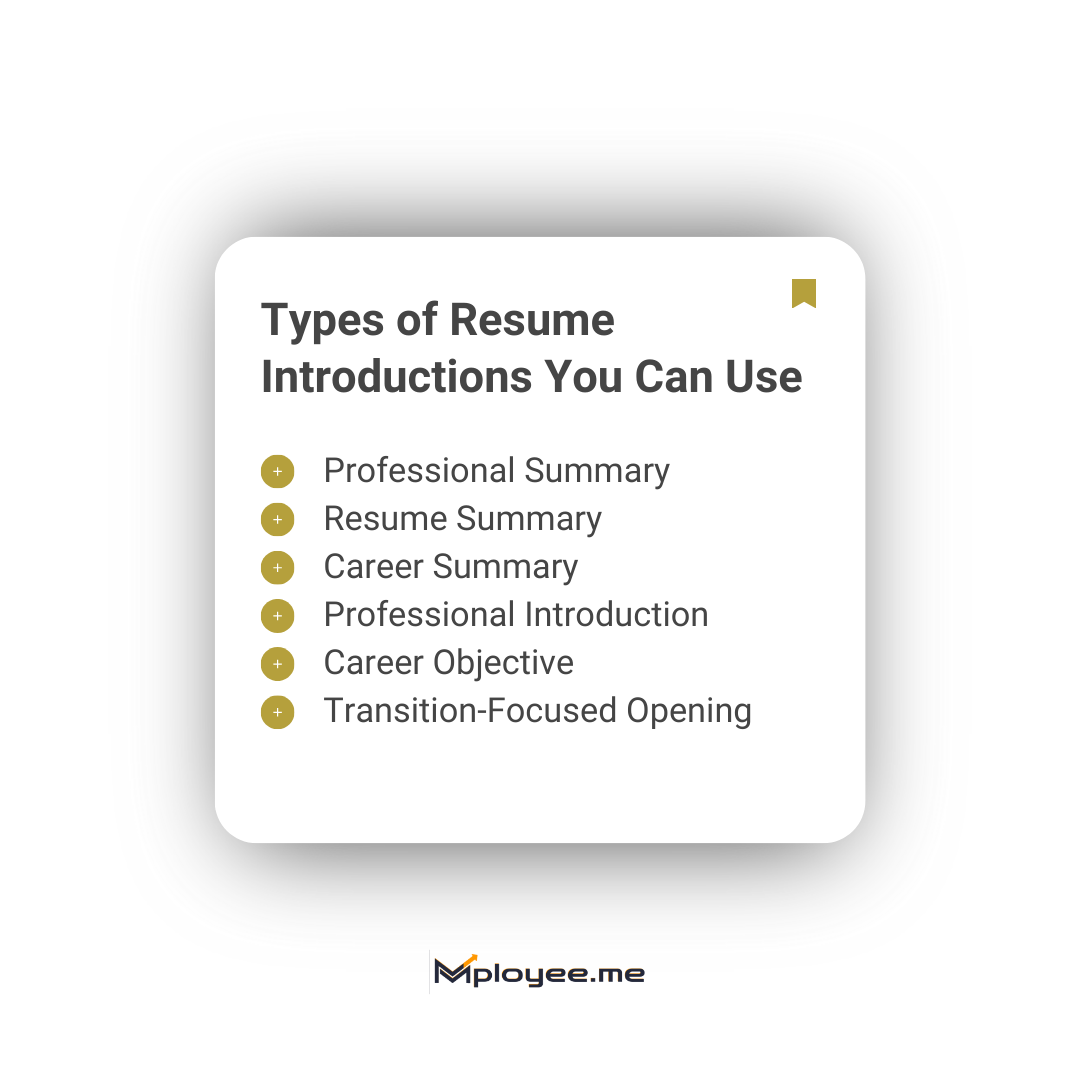
Types of Resume Introductions You Can Use
Different resume openings are needed for various career stages. By choosing the appropriate one, the relevancy gets better.
- Professional summary: Draws attention to experience and accomplishments, e.g. “Senior HR professional with 8 years of recruitment expertise.”
- Resume summary: Highlights skills and achievements but in a shorter version.
- Career summary: Displays long-term experience and career advancements concisely and logically.
- Professional introduction: Merges job role with the value bringer, e.g. “Finance analyst specializing in budgeting and forecasting.”
- Career objective: Basically indicates the career goal and purpose, mostly used by beginners.
- Transition-focused opening: It helps the applicant change their position by emphasizing their transferable skills.
The right format makes it easier to read. It allows the recruiters to quickly understand the intent behind the application.
How to Write a Resume Introduction That Hooks Recruiters?
To write a nice resume introduction one needs to be strategic and precise. Recruiters do not pay attention to the resume if they see some generic statements.
Step 1: Bring together Your Introduction With the Job Role
Begin by closely relating your resume introduction to the particular role you are applying for. It would be great if you could state the job title or the main obligation as recruiters will notice the significance instantly.
Step 2: Use Relevant Keywords That the Recruiters Expect
Integrate the job-related keywords that are frequently used such as tools, skills, and role-specific terms. This will not only improve visibility in ATS scans but also make your introduction recognizable to recruiters.
Step 3: Focus on Achievements and Not Responsibilities
Point out the measurable outcomes in place of the listing of duties. For example, instead of saying, “I was responsible for…,” you may say, “achievements like improved performance, enhanced efficiency, or project impact.”
Step 4: Clearly State Your Experience Level
Make it clear if you are a fresher, mid-level professional, or an experienced candidate. This will enable recruiters to quickly apprehend your seniority and expectations.
Step 5: Keep the Language Clear and Concise
Write in short, direct sentences that are easily scannable. Do not use long paragraphs, filler words, or unnecessary adjectives.
Step 6: Introduction Should Be Different for Each Application
The introduction of your resume should be written differently for each application to match the job description. Customization greatly enhances the likelihood of recruiter engagement and listing.
A systematic method increases clarity and impact. It assists in continually attracting the recruiter's interest over the entire application process.
Resume Introduction Examples (Role-Based)
Look at these 5 role-based resume introduction examples:
Results-driven marketing professional with 3+ years of experience executing digital campaigns that improved brand visibility and lead acquisition. Contributed to 20–30% growth in campaign engagement by applying performance-driven strategies, analyzing metrics, and collaborating with design and sales teams.
Motivated software developer fresher with a strong foundation in Java, Python, and web technologies, supported by 5+ academic and personal projects. Demonstrated problem-solving ability through 100+ coding challenges, with a strong interest in writing clean, scalable code in team-based environments.
Detail-oriented HR professional with 2+ years of experience supporting recruitment coordination, onboarding, and employee engagement initiatives. Assisted in hiring for 30+ roles, maintained accurate employee records, and contributed to improved process turnaround and candidate experience.
Analytical finance professional with experience in financial reporting, budgeting, and data analysis, supporting teams across monthly and quarterly reporting cycles. Contributed to improving reporting accuracy by 15–20% through data validation, reconciliation, and structured financial analysis.
Adaptable professional transitioning into a new career path with transferable experience across multiple roles and 6+ months of targeted upskilling. Leveraged analytical thinking, communication skills, and hands-on training projects to build role-specific competence and deliver measurable learning outcomes.
Best Practices for ATS-Friendly Resume Introduction
Applicant Tracking Systems first examine resume openings before the recruiters do. Optimization increases visibility.
- Simple formatting: Use plain text with no tables, icons, or graphics.
- Keyword matching: Make the wording align with the job description terms.
- Standard headings: Use the section titles that are most familiar and recognized by recruiters like “Experience,” “Skills,” and “Education.”
- Length control: Make sure the introduction is short and concise for better parsing.
- Consistent titles: Make sure the job titles are the same as those used by employers like “Digital Marketing Executive,” “Data Analyst,” and “Sales Manager.”
- Human balance: Make sure that the text still reads naturally to the recruiters.
ATS-friendly introductions are those which get a higher rank. They also increase the chances of getting the recruiter’s review.
Common Resume Introduction Mistakes to Avoid
Many resumes fail due to avoidable errors in the opening. These mistakes reduce impact immediately.
Mistake 1: Using Generic Statements
Generic opening lines fail to communicate real value and sound the same across resumes.
Do: Write a role-specific introduction that highlights relevant skills or results.
Don’t: Use vague phrases like “hardworking professional” or “results-oriented individual.”
Mistake 2: Not Targeting the Job Role
An untargeted introduction confuses recruiters about the position you are applying for.
Do: Clearly mention the job role or functional area in the opening lines.
Don't: Use the same resume introduction for multiple job applications.
Mistake 3: Focusing on Responsibilities Instead of Achievements
Listing duties does not show impact or performance.
Do: Highlight outcomes or contributions, such as improved efficiency or completed projects.
Don’t: Describe only what you were assigned to do without results.
Mistake 4: Making the Introduction Too Long
Lengthy introductions reduce readability and discourage quick scanning.
Do: Keep the introduction concise, clear, and easy to scan.
Don't: Write long paragraphs packed with unnecessary details.
Mistake 5: Being Unclear About Experience Level or Career Direction
Lack of clarity makes it hard for recruiters to assess fit quickly.
Do: Clearly state your experience level or career focus in the introduction.
Don’t: Leave recruiters guessing about your seniority or career direction.
Key Takeaways
A powerful resume introduction not only sets the mood for your whole job application but also has a direct effect on recruiter interest.
- Since recruiters only take a few seconds to look through a resume, having a clear and concise introduction to your resume is really important.
- An opening that is well written attracts the attention of the recruiter by briefly saying who you are and what you can give.
- Selection of the correct layout, be it professional summary, career summary, or career objective, increases the relevance.
- Connecting your resume introduction with the job role and keywords enhances both ATS and recruiter visibility.
- Incorporating the accomplishments in the introduction gives your profile more credibility and makes it more potent.
- Making the introduction specific to every job application greatly increases the chances of being shortlisted.
- Steering clear of vague language and not-so-clear career aspirations immediately gives your resume the edge over others.
- A brief and to the point, focused resume introduction directs the recruiters to the rest of your resume with interest.
If done properly, your resume introduction can be a strong hook. It not only boosts visibility but also attracts the recruiters' attention.
How do I introduce myself to a recruiter?
The recruiter can get to know you better by hearing you out in short how you are, where you work, and what you can give as a value. An unmistakable self-introduction is all about your position, primary abilities, and one impressive result or advantage. It conveys your profile to the recruiter in a matter of seconds.
What is a good introduction line for a resume?
What is the 7 second rule in a resume?
How do I share my resume to a recruiter?
How do I introduce myself on my resume?

Got Your Answer ?
Learn this in 30 Seconds 👇

Career Blogs
Our career blog is your go-to resource for insightful advice, practical tips, and the latest trends in the job market.


Office Address: Room No 305, IIT ROPAR-TBIF, Top Floor (East Wing), M.Visvesvaraya, Rupnagar PB, 140001
- Free Online Resume Review
- Check Resume Score
- Job Description Keyword Finder
- Resume Shortlisting Software
- Resume Scanner for Jobs
- Find jobs that match with resume
- Job matching platform
- Resume job matching
- Job suggestion
- Best sites to find jobs
- Free ats resume scanner
- Auto apply for job
- Full Time Jobs
- I Need a Job
- Information Technology Jobs
Can't Find Something? Get in Touch.
©2026 Padhakku Peek A Book Pvt Ltd (Mployee.me)


